The 30 Minute Rule begins April 15 at 7:00 PM EDT. An Initial Bid Must Be Placed By April 15 at 6:00 PM EDT To Participate After 6:00 PM EDT
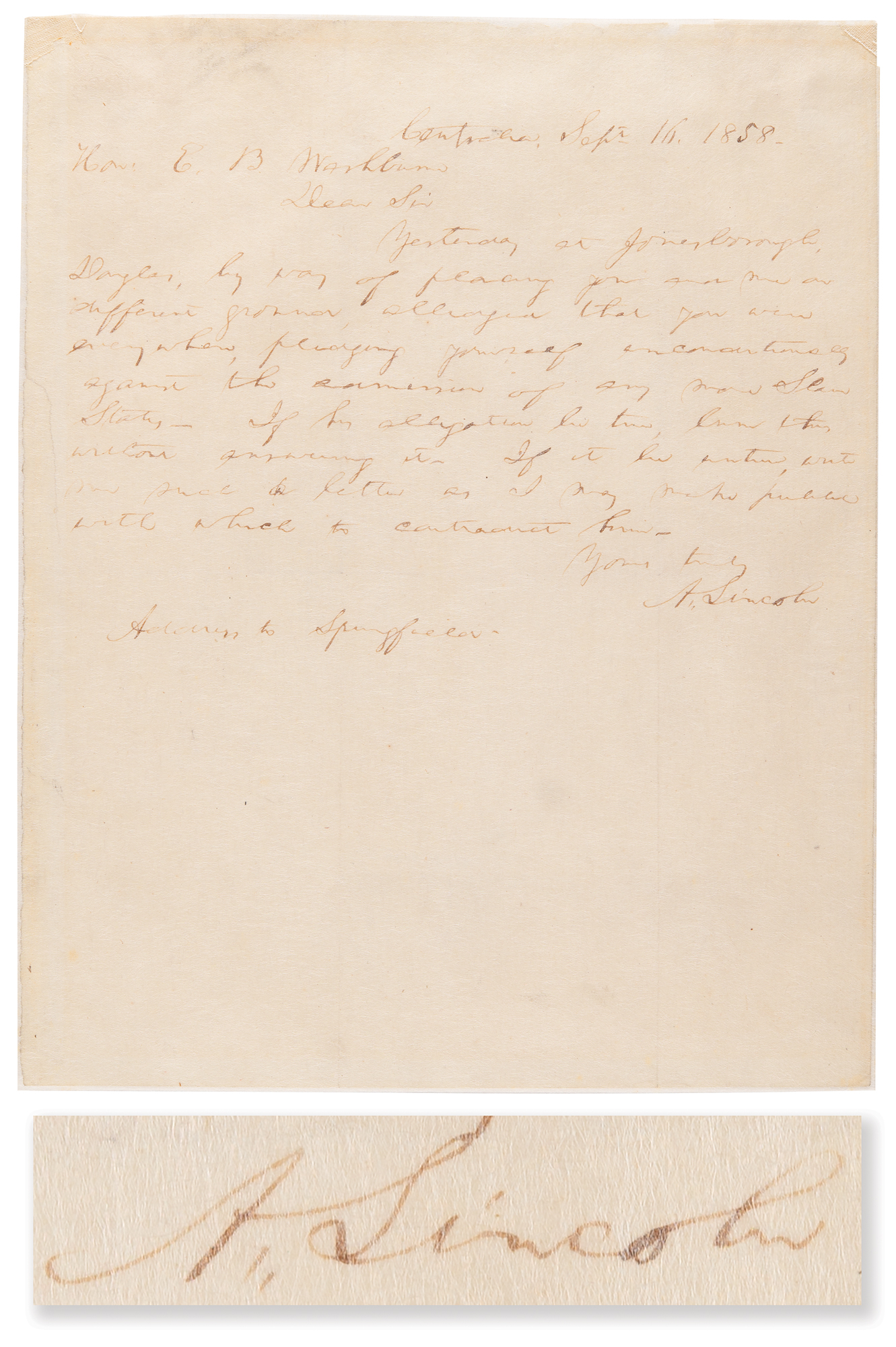
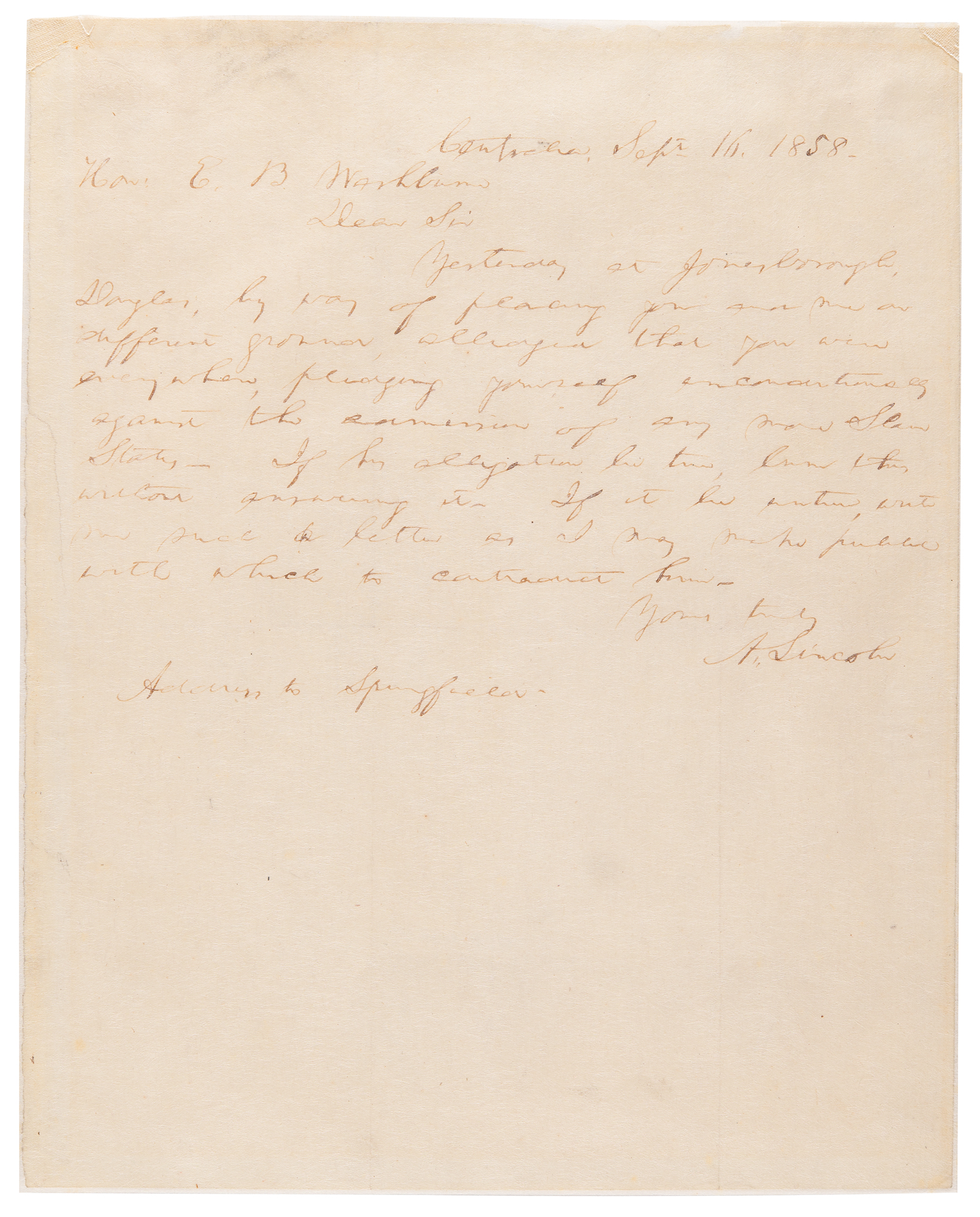
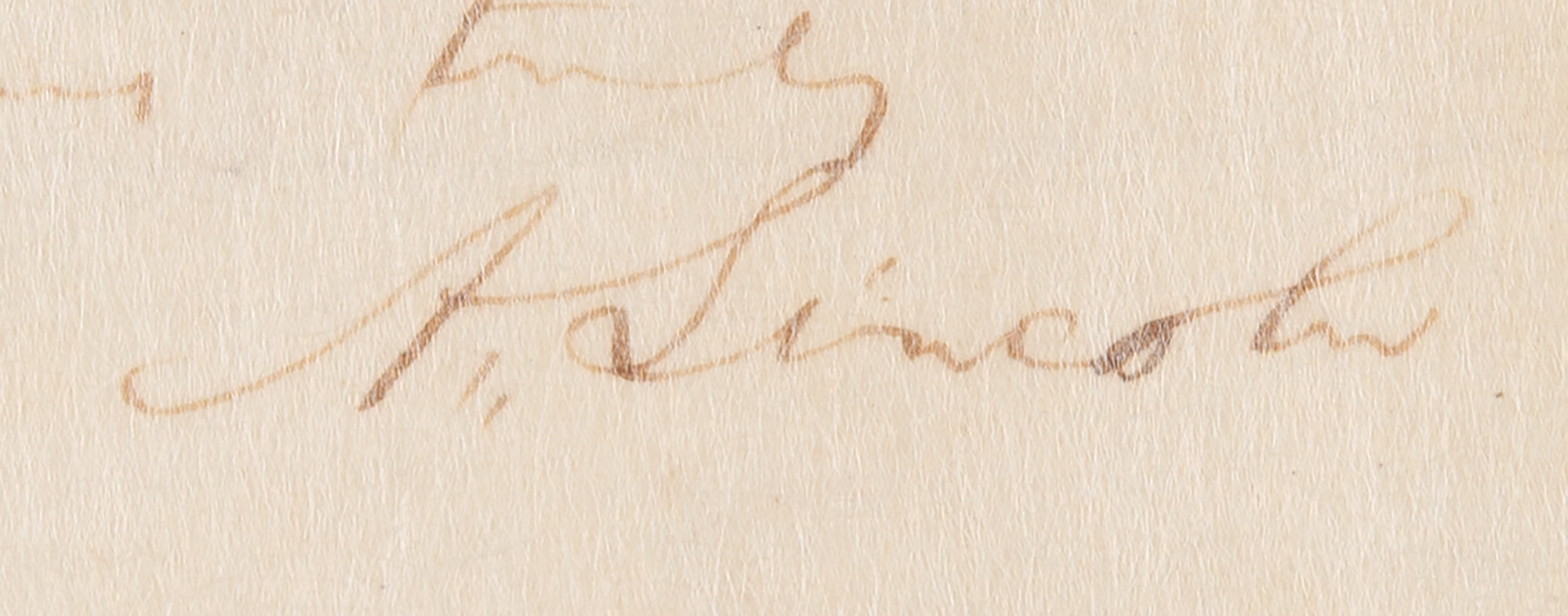
Historic ALS signed “A. Lincoln,” one page, 7.75 x 9.75, September 16, 1858. Handwritten letter to Congressman Elihu B. Washburne, concerning an allegation made by Stephen Douglas against Washburne at the preceding Lincoln-Douglas debate in Jonesboro, Illinois. Lincoln addressed the letter from Centralia, Illinois, a city about 80 miles north of Jonesboro and about 100 miles southwest of Charleston, Illinois, the site of Lincoln's next debate with Douglas two days later. Lincoln took the evening northbound train from Centralia on his way to Charleston.
The letter, in full: “Yesterday at Jonesborough, Douglas, by way of placing you and me on different ground, alledged that you were everywhere, pledging yourself unconditionally against the admission of any more Slave States. If his allegation be true, burn this without answering it. If it be untrue, write me such a letter as I may make public with which to contradict him.” To the lower left, Lincoln adds, “Address to Springfield.” Elihu B. Washburne was elected as a Whig to the 33rd Congress in 1852 and was reelected as a Republican in 1854 and 1856. By this time, he was seeking his fourth term in Congress and had been present at the second Lincoln-Douglas debate held in his congressional district of Freeport on August 27, 1858. Includes a handsome presentation folder with quarter-bound slipcase. Professionally cleaned, rice paper-backed, and restored to near-fine condition. An astounding Lincoln letter that mentions both his pivotal debates with Douglas and the admission of slave states to the Union, the issue that divided the nation and led to the Civil War.
The day before, in their third debate held at Jonesboro, Illinois, on September 15, 1858, Sen. Stephen A. Douglas said, in part, ‘But Mr. Lincoln does not want to be held responsible for the Black Republican doctrine of no more slave States…Washburne, the Black Republican candidate for Congress in the Galena district, is making speeches in favor of this same abolition platform declaring no more slave States. Why are men running for Congress in the northern districts, and taking that abolition platform for their guide, when Mr. Lincoln does not want to be held to it down here in Egypt and in the centre of the State, and objects to it so as to get votes here.’
In the Freeport debates on August 27, 1858, Lincoln affirmed that he was not against the admission of new slave states, stating: ‘I do not now, nor ever did, stand pledged against the admission of any more slave states into the Union.’ Lincoln’s stance seemed clear, but Douglas, a shrewd politician, called into doubt his sincerity by referencing fellow party members like Washburne while emphasizing Lincoln’s adherence to his party's abolitionist platform and advocacy of social equality between the races, a radical position guaranteed to cause Lincoln to lose.
In Jonesboro, Lincoln stayed firm by challenging the implications of the Dred Scott decision, stating that the Supreme Court had ruled ‘any Congressional prohibition of slavery in the Territories is unconstitutional.’ He then asked his audience: ‘What would be the first thing you would have to do before entering upon your duties? Swear to support the Constitution of the United States.’ Lincoln emphasized that failing to support such rights, while claiming to uphold the Constitution, would be a contradiction, and concluded that if he accepted the Dred Scott decision as a correct interpretation of the Constitution, then refusing to support slavery in the territories would make him ‘a perjured man.’ Lincoln’s counter made it clear that he would be violating his duty to support the Constitution if he were against the admission of any more Slave States.
Over the next two debates, held in Charleston and Galesburg, Douglas continued to accuse Lincoln and the Republican Party of hypocrisy, arguing that Republicans said one thing in the North and another in the South, all while mocking Lincoln for supposedly distancing himself from a position his supporters openly embraced. He questioned Lincoln’s leadership and accused him of political evasiveness: ‘Why cannot Abraham Lincoln… speak out their principles so that they may be understood?’
Douglas defeated Lincoln for the Senate seat, but Lincoln's popularity was boosted by the debates, setting the stage for his presidential election in 1860. After that election, Washburne and William Seward were appointed to meet and escort the newly elected president to his hotel upon his first arrival in Washington in 1861. Washburne later served as President Grant's Secretary of State.
The Lincoln letter here offered is published in Roy P. Basler's ‘The Complete Works of Abraham Lincoln’ (Rutgers University Press, 1953). Basler notes, ‘Apparently, Washburne did not reply to this letter, for in the Lincoln Papers there are no Washburne letters between May 31, 1858 and May 20, 1860.’ It is possible that Washburne did reply, addressing his letter “to Springfield” as requested by Lincoln, but Lincoln would not have received it until he returned home on October 16th after the final debate with Douglas. If he did receive Washburne's reply, the issue was now moot, so Lincoln may have destroyed it. According to The Collected Works, after Elihu Washburne died, this letter was owned by his son, Hempstead Washburne.

This item is Pre-Certified by PSA/DNA
Buy a third-party letter of authenticity for
$500.00
*This item has been pre-certified by a trusted third-party authentication service, and by placing a bid on this item, you agree to accept the opinion of this authentication service. If you wish to have an opinion rendered by a different authenticator of your choosing, you must do so prior to your placing of any bid. RR Auction is not responsible for differing opinions submitted 30 days after the date of the sale.