

The 30 Minute Rule begins April 23 at 7:00 PM EDT. An Initial Bid Must Be Placed By April 23 at 6:00 PM EDT To Participate After 6:00 PM EDT
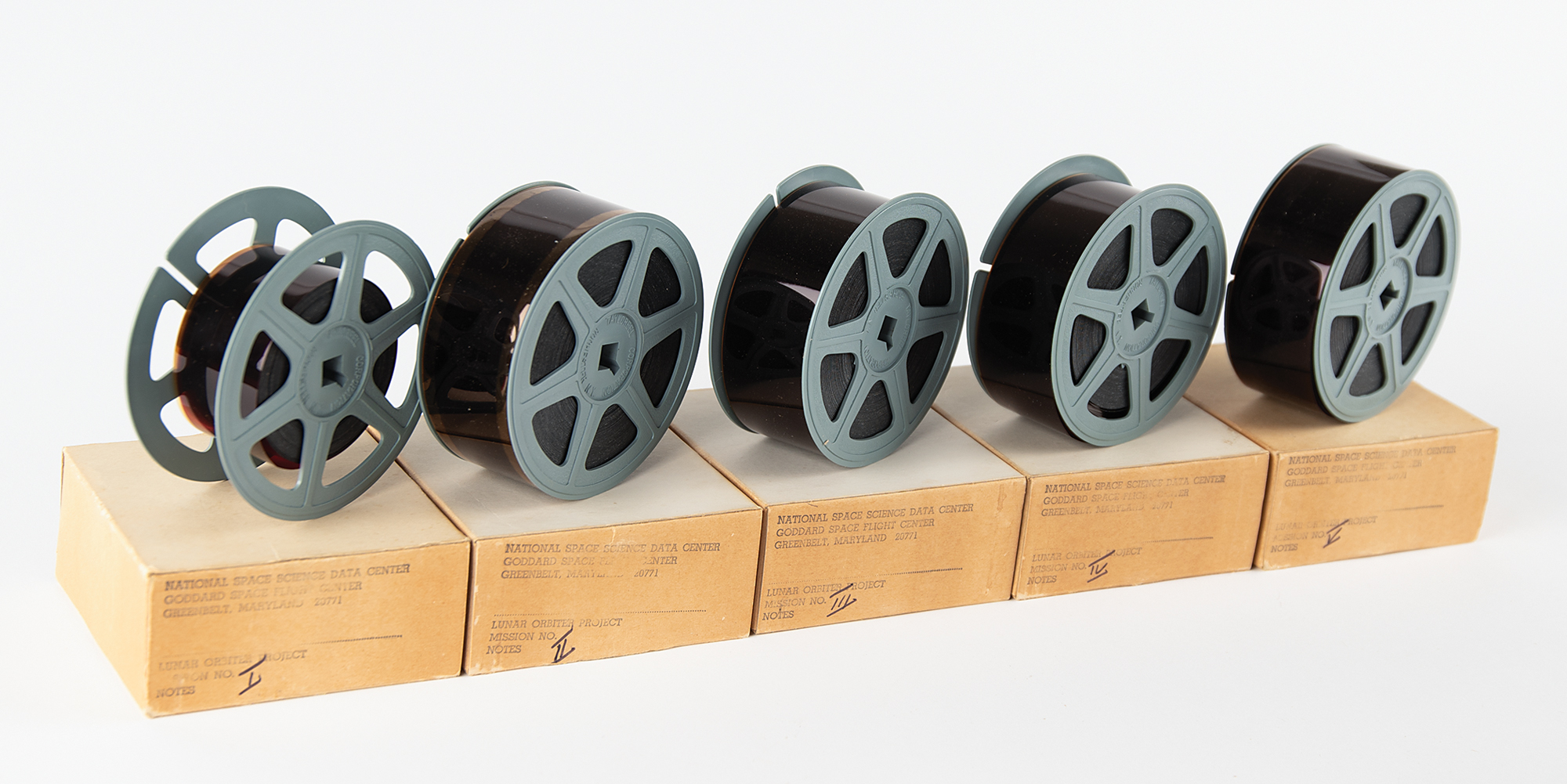
Complete set of five 35mm film reels containing hundreds of images produced as part of the historic Lunar Orbiter program, a series of five uncrewed lunar orbiters launched by the United States in 1966 and 1967. Intended to help select Apollo landing sites by mapping the Moon’s surface, these missions photographed roughly 99% of the Moon and released the first photographs taken from lunar orbit, returning extensive imagery of both the lunar surface and Earth.
The photographs on these reels were microfilmed in August 1968 by the National Space Science Data Center (NSSDC) from prints produced from original negatives prepared by the U.S. Army Map Service, the Boeing Company, and Eastman Kodak. Most of the prints selected for filming were supplied by the Lunar Orbiter Project Office at NASA’s Langley Research Center. According to accompanying documentation, all usable images taken during the five Lunar Orbiter missions were preserved across five reels of microfilm, intended for investigators studying Lunar Orbiter photographic data.
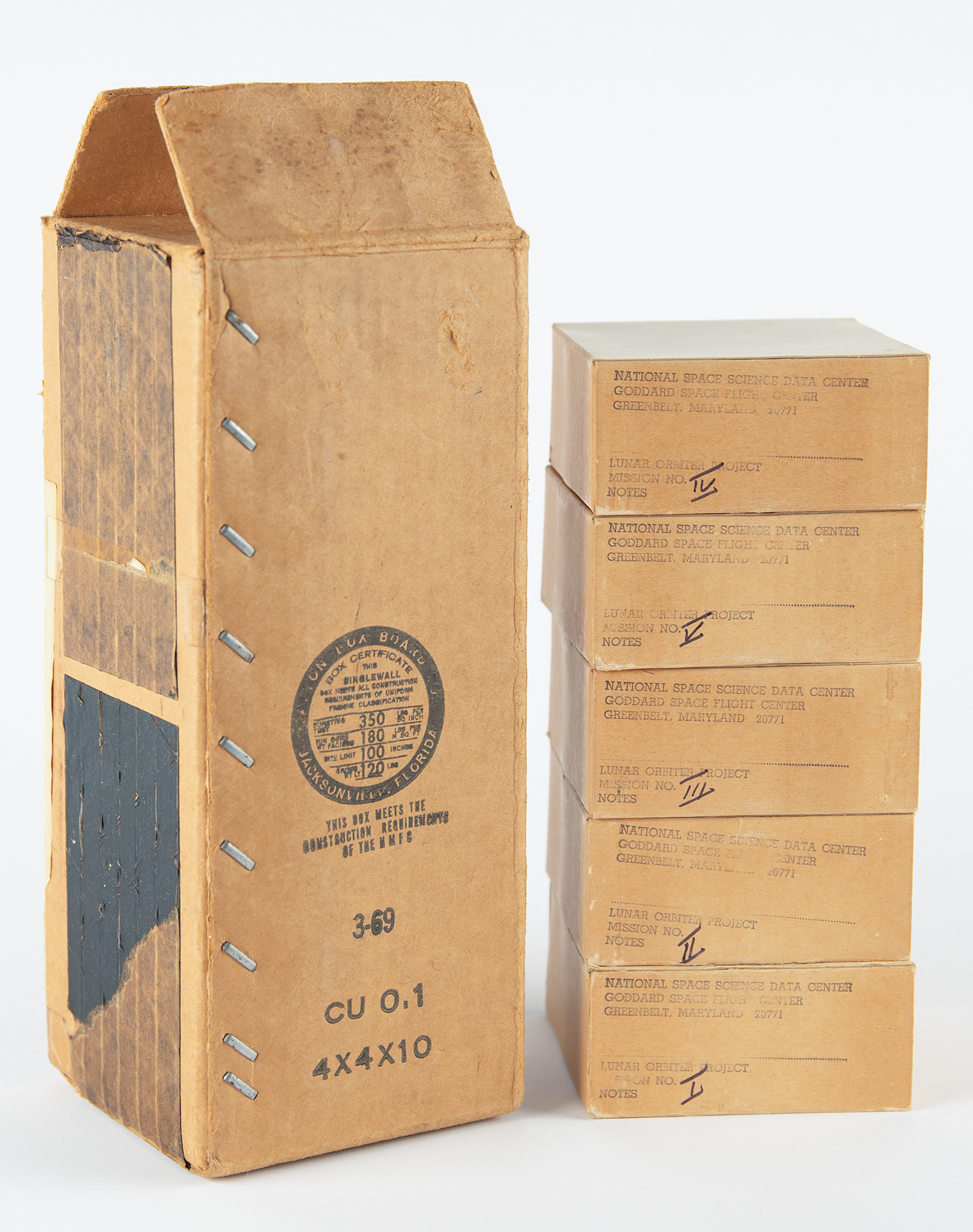
Each film reel is housed in its original box, measuring 3.75˝ x 3.75˝ x 1.75˝, with the front flap stamped with the address, “National Space Science Data Center, Goddard Space Flight Center, Greenbelt, Maryland 20771,” above a field marked “Lunar Orbiter Project,” identifying the reel’s respective mission in black felt tip Roman numerals—I, II, III, IV, and V. Each box contains a gray plastic film reel, 3.75˝ in diameter, manufactured by the Tayloreel Corporation of Rochester, New York.
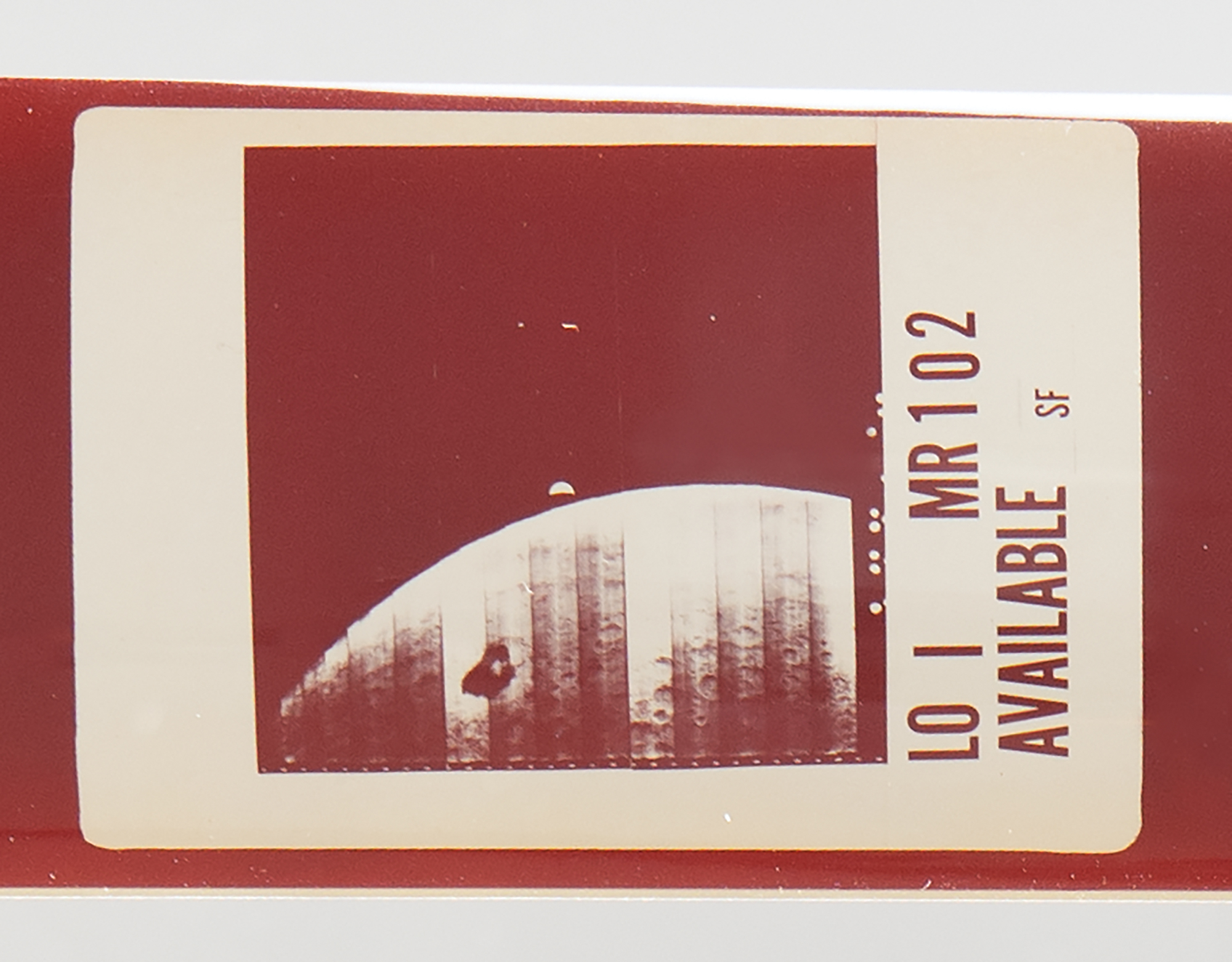
Of significant interest is the reel for the Lunar Orbiter 1 mission, which includes Frame 102, the famous ‘Earthrise’ photograph taken on August 23, 1966, the first image of Earth captured from the vicinity of the Moon. Taken by the spacecraft’s medium-resolution camera while orbiting about 1,200 miles above the lunar surface, it shows Earth rising above the Moon’s horizon and became one of the earliest iconic views of our planet from space, captured two years before the astronaut-photographed Earthrise during Apollo 8.
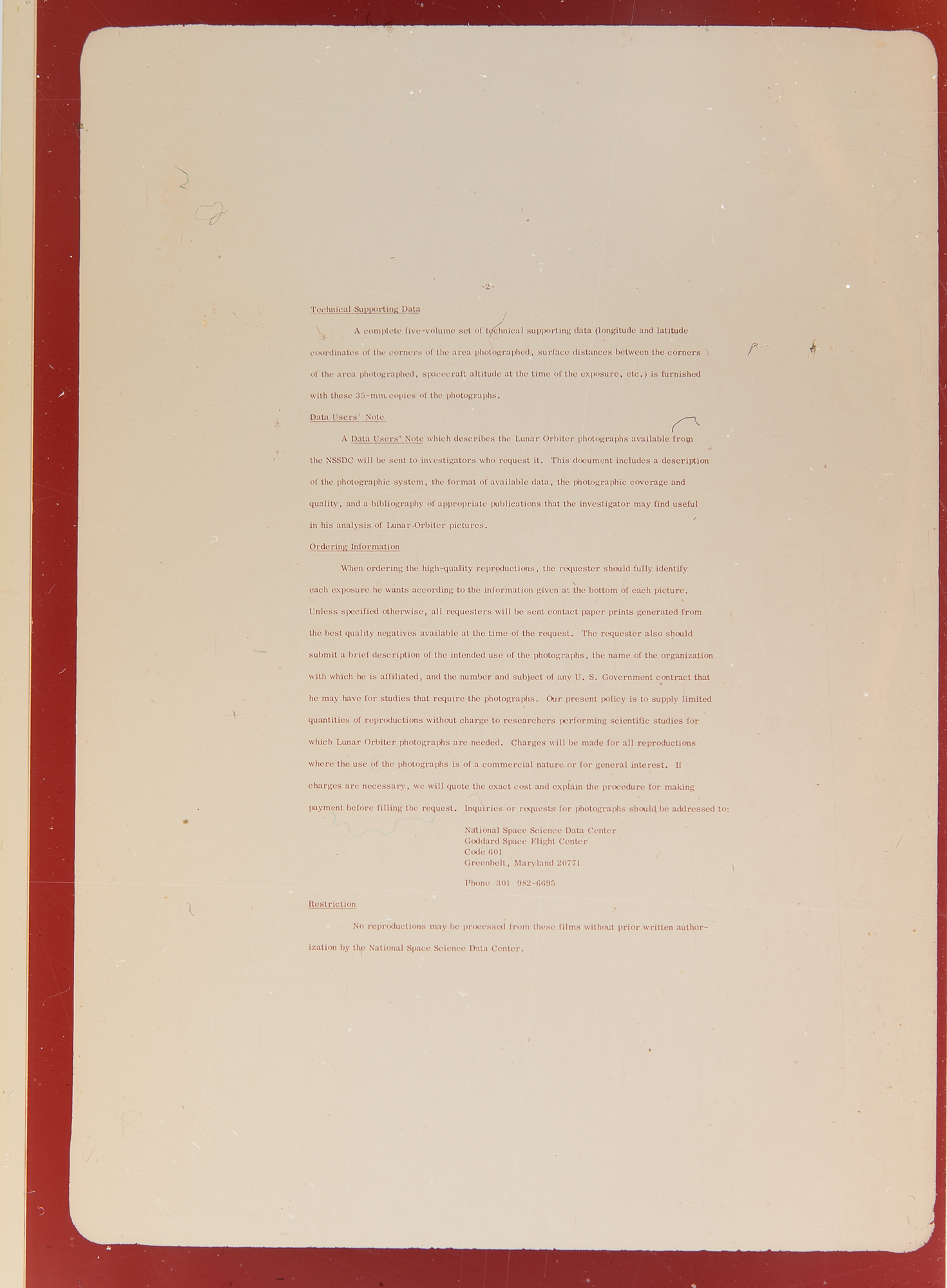
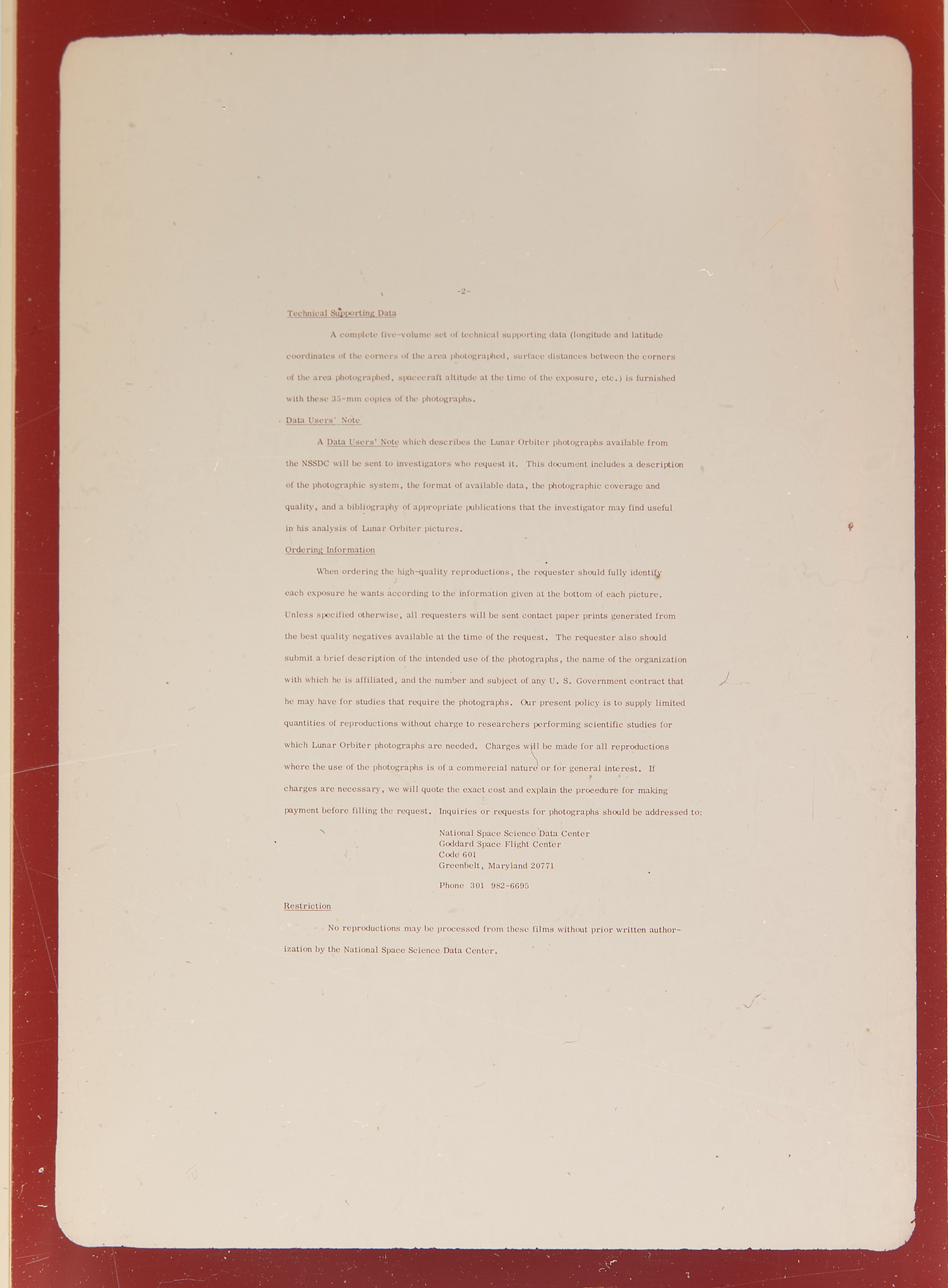
Each reel begins with two frames of an informational letter from the NSSDC dated August 1968, which describes the Lunar Orbiter microfilm photographs, their sources and identification system, and provides instructions for researchers on the use and ordering of high-quality reproductions. The Lunar Orbiter 1 reel begins with frame “MR007”; frames “MR005” and “MR006” are included as individual microfilm frames.
Complete with the original cardboard shipping box, which bears an early NASA “Official Business” postage label and, amusingly, a “Scientific Material, No Monetary Value” stamp. In overall fine condition.
The NSSDC letter reads:
“MICROFILM REPRODUCTIONS OF LUNAR ORBITER 1–5 PHOTOGRAPHS
Description of Data
The Lunar Orbiter photographs which appear on the subsequent frames were microfilmed by the National Space Science Data Center (NSSDC). These microfilm images were made from prints produced from negatives prepared by the U.S. Army Map Service, the Boeing Company, and the Eastman Kodak Company. Most of the prints selected for filming were supplied by the Lunar Orbiter Project Office at the NASA Langley Research Center. The remainder of prints filmed were produced by NSSDC.
The Lunar Orbiter Project Office is currently in the process of electronically enhancing the image detail of all Lunar Orbiter photographs. When complete sets of these improved films are received, expected early in 1969, reproductions supplied to requesters by the NSSDC will be processed from the Langley Research Center enhanced negatives.
Use of Microfilms
The image quality of this set of microfilms is somewhat less than that of contact prints or films. Investigators who are interested in Lunar Orbiter photographic data can use these microfilms as working data for many purposes; however, they can also be used as a guide for selecting high-quality reproductions necessary for more exact studies. All usable pictures taken during the five Lunar Orbiter missions are contained on five reels of microfilm.
Identification
Each frame on these films has an identification block. The first line of the two-line identification presents the mission number (Lunar Orbiter Mission I, II, III, IV, or V), the lens system which exposed the photograph (MR for moderate resolution and HR for high resolution), the exposure number (given to three digits), and the component part of the usually three-part high-resolution frame (e.g., 2 of 3 represents the image as being the second of three component images necessary to show the full coverage of the high-resolution camera lens). The second line identifies the format(s) of film negatives from which NSSDC can process reproductions. (“SF” denotes the 9-1/2-inch subframe negatives prepared by Eastman Kodak, “16 × 20” identifies the negatives prepared by Boeing, and “20 × 24” denotes negatives prepared by the U.S. Army Map Service.)
Technical Supporting Data
A complete five-volume set of technical supporting data (longitude and latitude coordinates of the corners of the area photographed, surface distances between the corners of the area photographed, spacecraft altitude at the time of the exposure, etc.) is furnished with these 35-mm copies of the photographs.
Data Users’ Note
A Data Users’ Note which describes the Lunar Orbiter photographs available from the NSSDC will be sent to investigators who request it. This document includes a description of the photographic system, the format of available data, the photographic coverage and quality, and a bibliography of appropriate publications that the investigator may find useful in his analysis of Lunar Orbiter pictures.
Ordering Information
When ordering the high-quality reproductions, the requester should fully identify each exposure he wants according to the information given at the bottom of each picture. Unless specified otherwise, all requesters will be sent contact paper prints generated from the best quality negatives available at the time of the request. The requester also should submit a brief description of the intended use of the photographs, the name of the organization with which he is affiliated, and the number and subject of any U. S. Government contract that he may have for studies that require the photographs. Our present policy is to supply limited quantities of reproductions without charge to researchers performing scientific studies for which Lunar Orbiter photographs are needed. Charges will be made for all reproductions where the use of the photographs is of a commercial nature or for general interest. If charges are necessary, we will quote the exact cost and explain the procedure for making payment before filling the request. Inquiries or requests for photographs should be addressed to:
National Space Science Data Center
Goddard Space Flight Center
Code 601
Greenbelt, Maryland 20771
Phone 301 982-6695
Restriction
No reproductions may be processed from these films without prior written authorization by the National Space Science Data Center.”