The 30 Minute Rule begins April 15 at 7:00 PM EDT. An Initial Bid Must Be Placed By April 15 at 6:00 PM EDT To Participate After 6:00 PM EDT
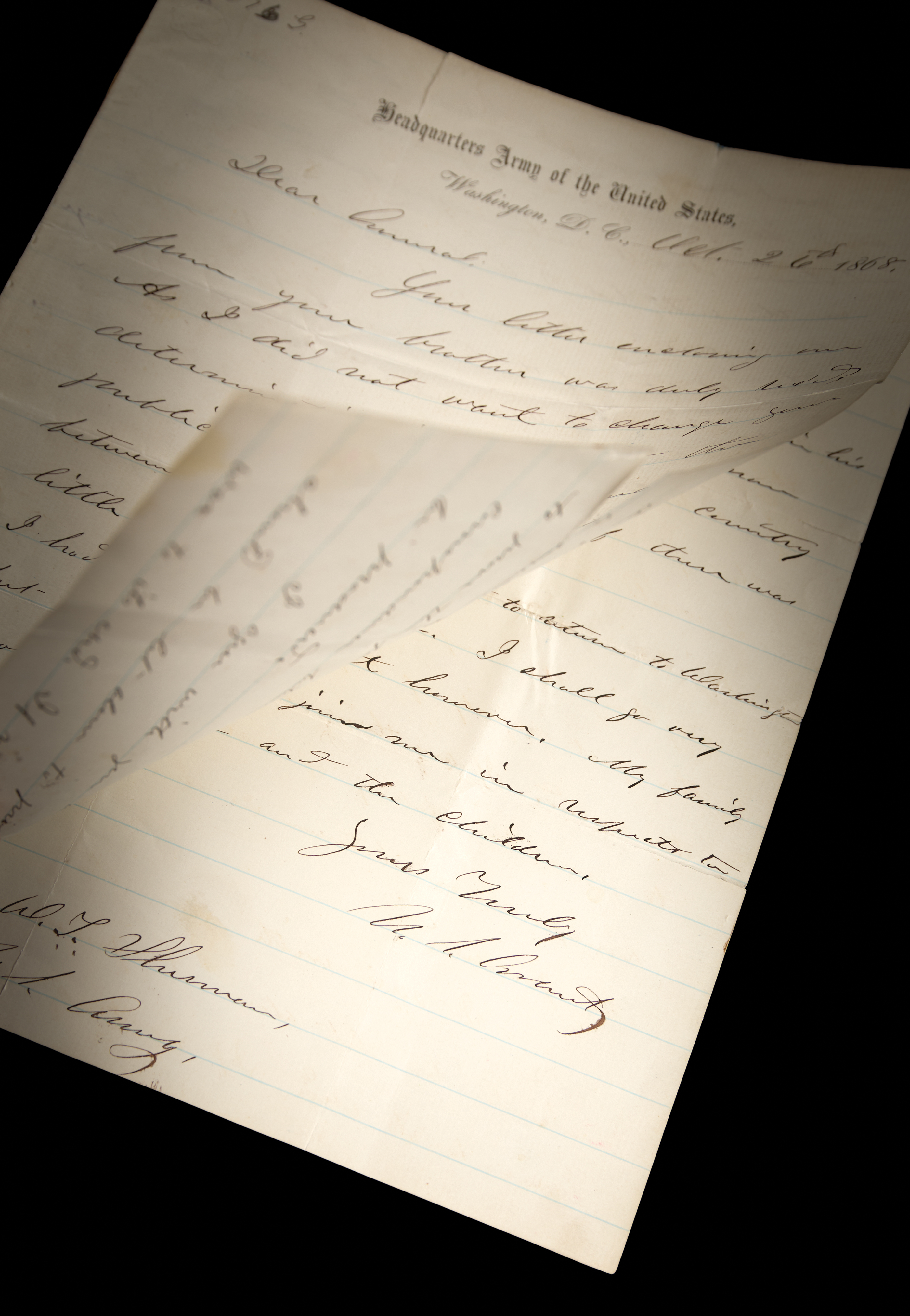
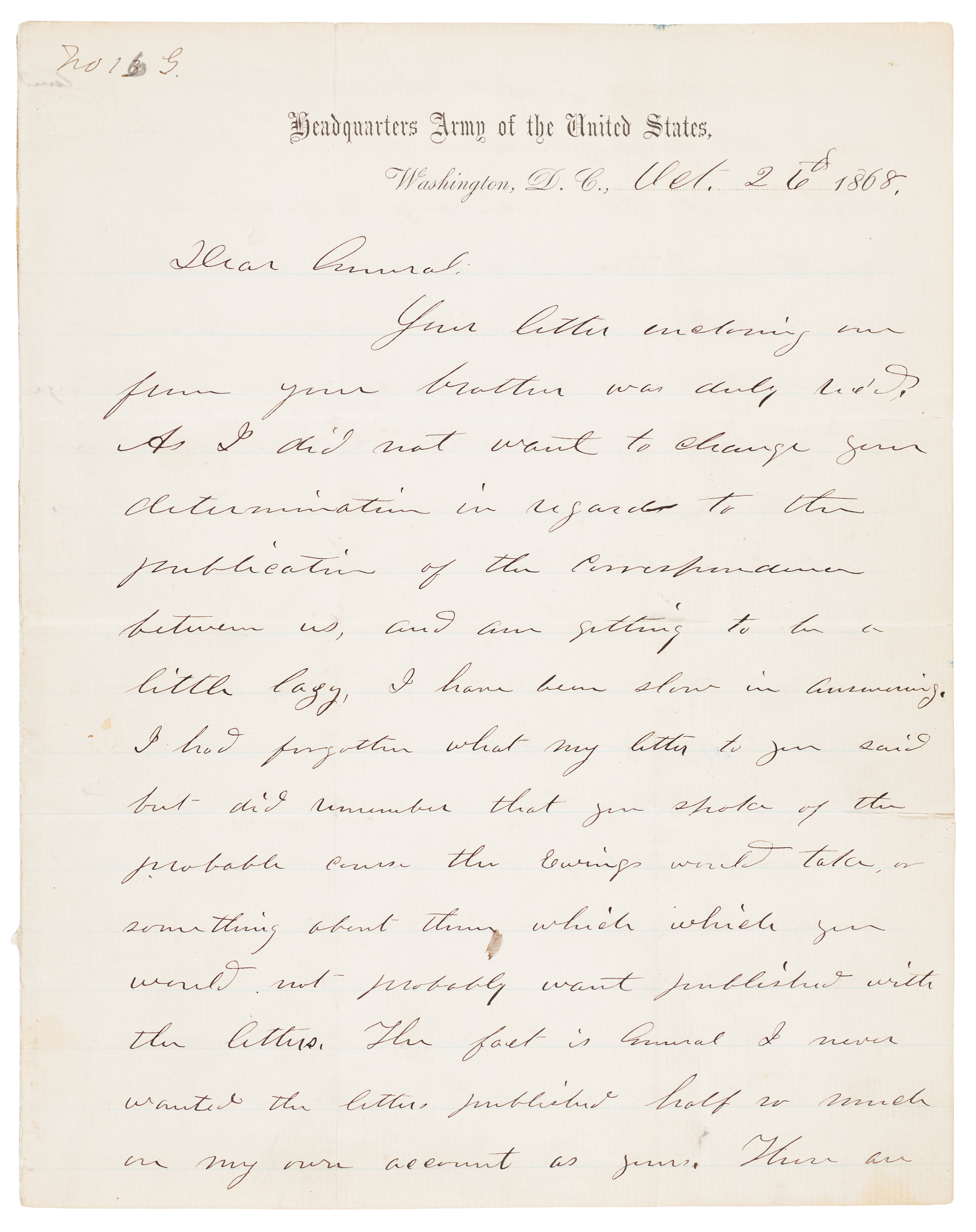
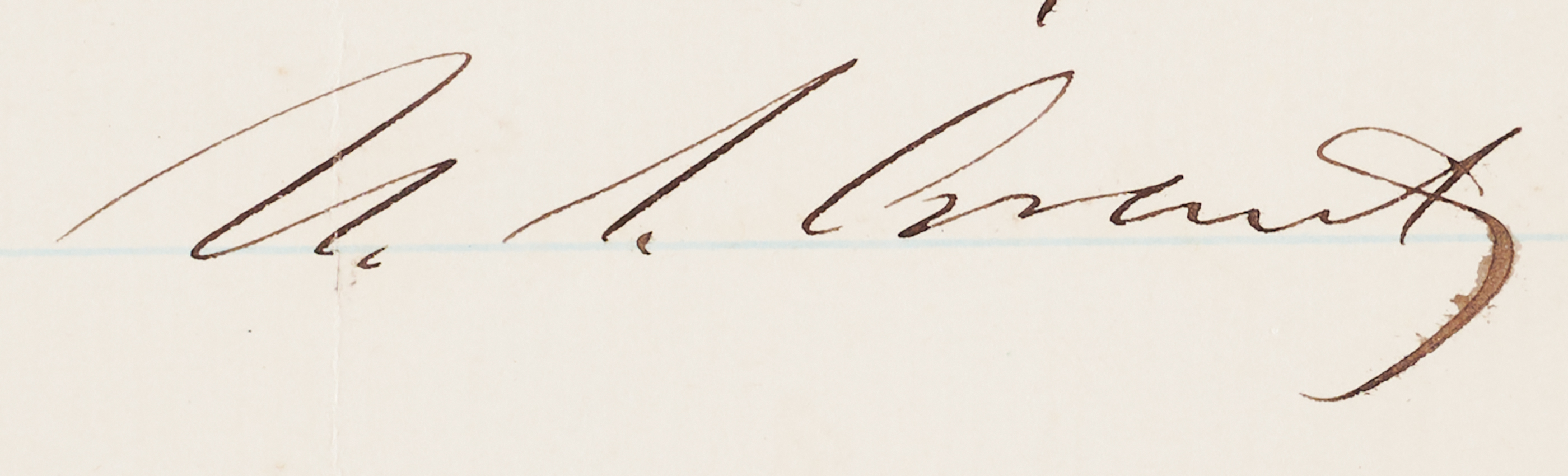
ALS signed “U. S. Grant,” three pages on two adjoining sheets, 7.75 x 10, Headquarters Army of the United States letterhead, October 26, 1868. Handwritten letter to "Lt. Gen. W. T. Sherman, U.S. Army," written just days before the presidential election of 1868. In full: "Your letter enclosing one from your brother was duly rec'd. As I did not want to change your determination in regard to the publication of the correspondence between us, and am getting to be a little lazy, I have been slow in answering. I had forgotten what my letter to you said but did remember that you spoke of the probable course the Ewings would take, or something absent them, which which you would not probably want published with the letters. The fact is General I never wanted the letters published half so much as my own account as yours.
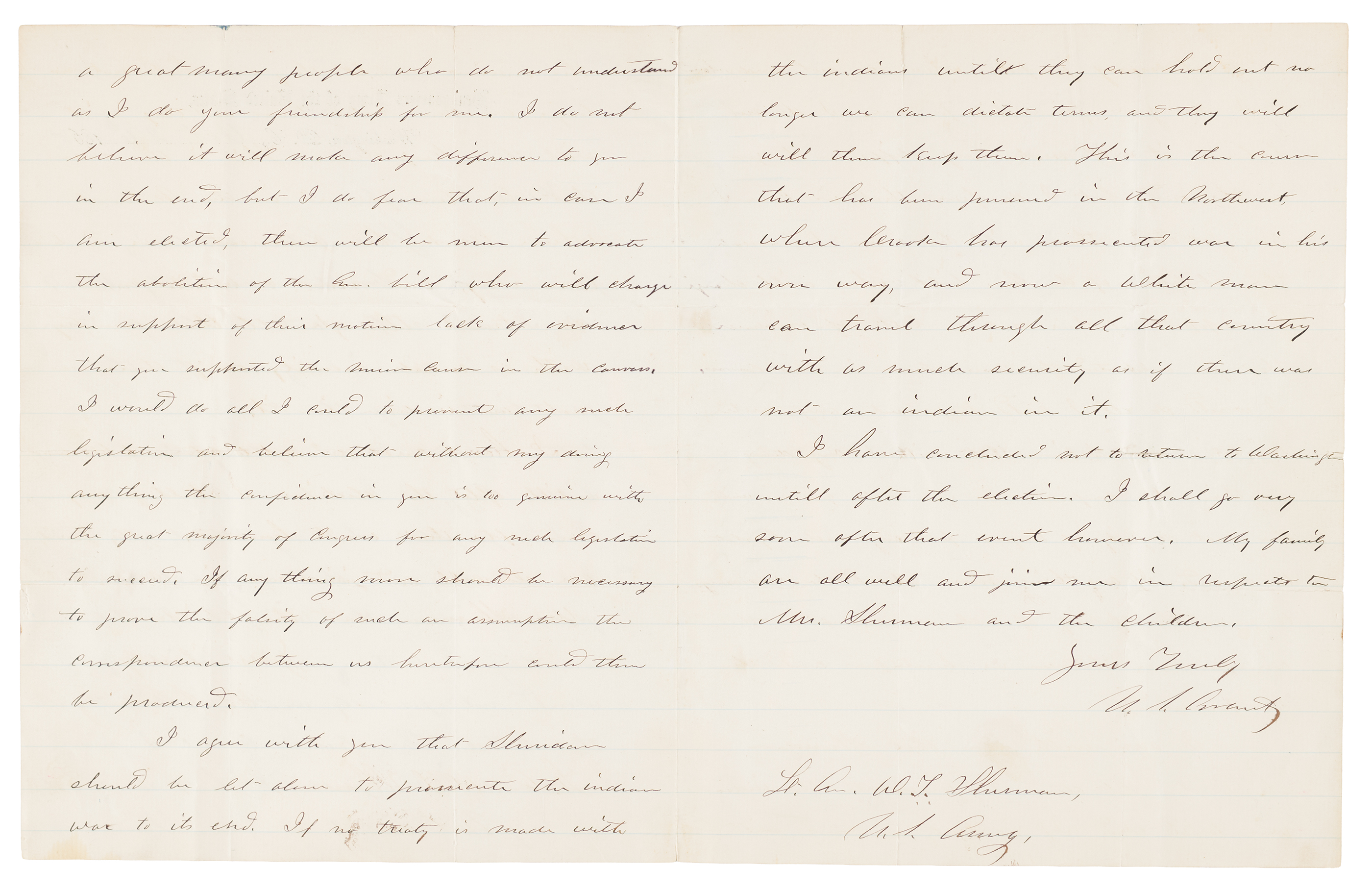
There are a great many people who do not understand as I do your friendship for me. I do not believe it will make any difference to you in the end, but I do fear that, in case I am elected, there will be men to advocate the abolition of the Gen. bill who will charge in support of their motion lack of evidence that you supported the Union cause in the canvass. I would do all I could to prevent any such legislation and believe that without my doing anything the confidence in you is too genuine with the great majority of Congress for any such legislation to succeed. If any thing more should be necessary to prove the falsity of such an assumption the correspondence between us heretofore could then be produced.
I agree with you that Sheridan should be let alone to prosecute the indian war to its end. If no treaty is made with the indians untill they can hold out no longer we can dictate terms, and they will then keep them. This is the cause that has been pursued in the Northwest, where Crook has prosecuted war in his own way, and now a White man can travel through all that country with as much serenity as if there was not an indian in it.
I have concluded not to return to Washington untill after the election. I shall go very soon after that event however. My family are all well and join me in respects to Mrs. Sherman and the children."
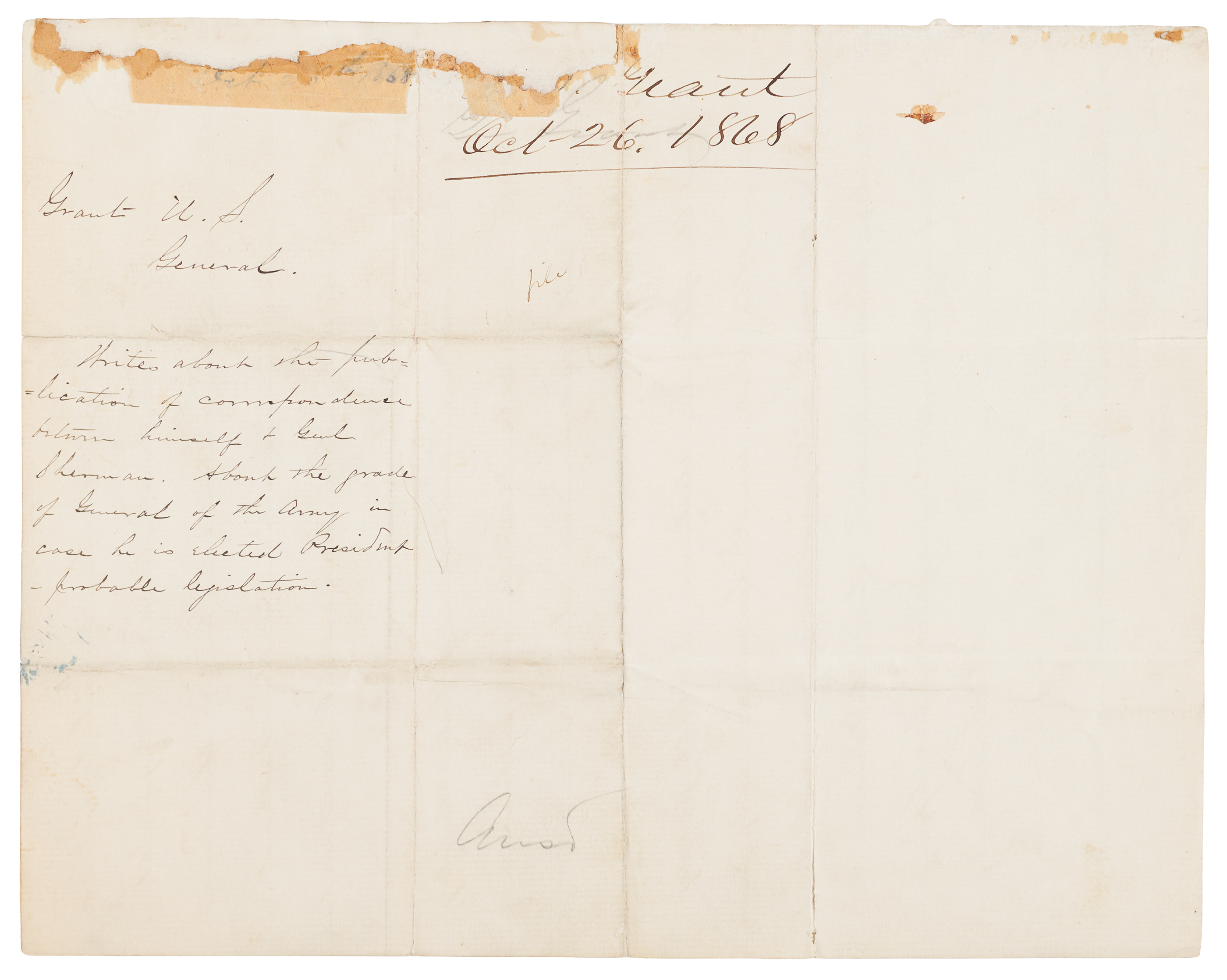
William T. Sherman dockets the reverse in his own hand, in full: "Grant, U. S., General, Writes about the publication of correspondence between himself & Genl. Sherman. About the grade of General of the Army in case he is elected President—probable legislation." In fine condition, with minor splitting to the ends of the folds, and some old mounting remnants to the back of the last page.
This letter finds Ulysses S. Grant balancing his roles as commanding general of the U.S. Army and Republican nominee for president. Grant expresses concern that, if elected, hostile members of Congress might revive efforts to remove the special rank of General of the Army by untruthfully asserting that William T. Sherman had failed to support the Union cause during the canvass.
Grant was preparing to relinquish the rank—created for him by Congress in 1866—upon assuming the presidency, a transition that would elevate Sherman to that position. His concern reflects an awareness that the rank itself remained subject to political attack, and that efforts to abolish it could directly affect Sherman’s standing—revealing how closely personal loyalties and congressional politics were intertwined on the eve of Grant’s election. These fears proved unfounded, and Sherman would indeed succeed Grant as General of the Army on March 4, 1869, the day of Grant’s inauguration.
Grant also addresses ongoing military operations, explicitly endorsing Philip H. Sheridan’s authority to prosecute the Indian wars without interference, advocating for sustained military pressure. He cites George Crook’s campaigns in the Northwest as a model, reflecting prevailing Army doctrine and foreshadowing the continuity of policy: first under Sherman, and later under Sheridan himself. Sheridan, too, would be named General of the Army in 1888, shortly before his death; the honor was then retired until World War II. The letter thus links politics, the U.S. military's senior command, and federal Indian policy at a critical moment preceding the first election of the Reconstruction Era.

This item is Pre-Certified by PSA/DNA
Buy a third-party letter of authenticity for
$100.00
*This item has been pre-certified by a trusted third-party authentication service, and by placing a bid on this item, you agree to accept the opinion of this authentication service. If you wish to have an opinion rendered by a different authenticator of your choosing, you must do so prior to your placing of any bid. RR Auction is not responsible for differing opinions submitted 30 days after the date of the sale.