The 30 Minute Rule begins April 15 at 7:00 PM EDT. An Initial Bid Must Be Placed By April 15 at 6:00 PM EDT To Participate After 6:00 PM EDT
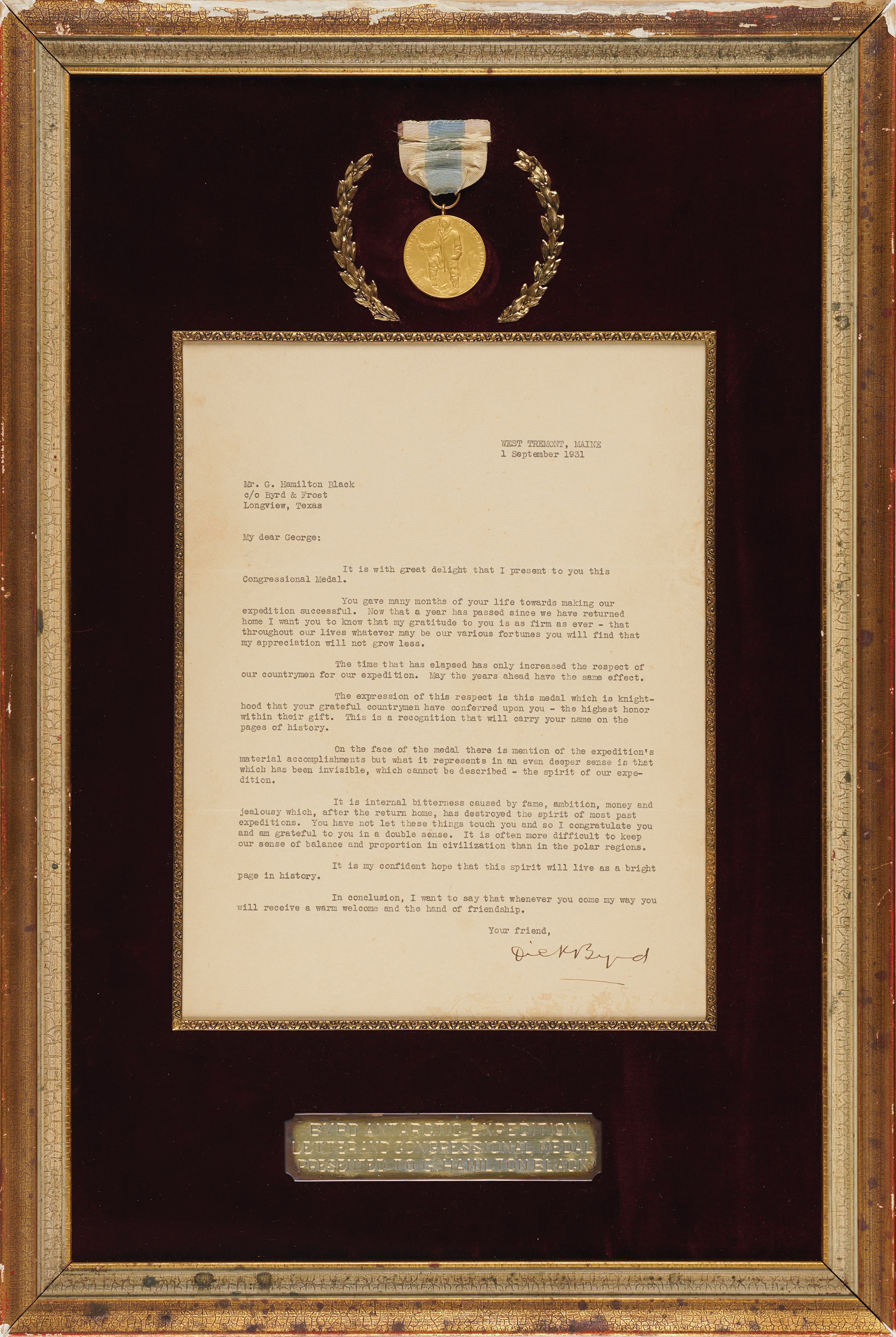
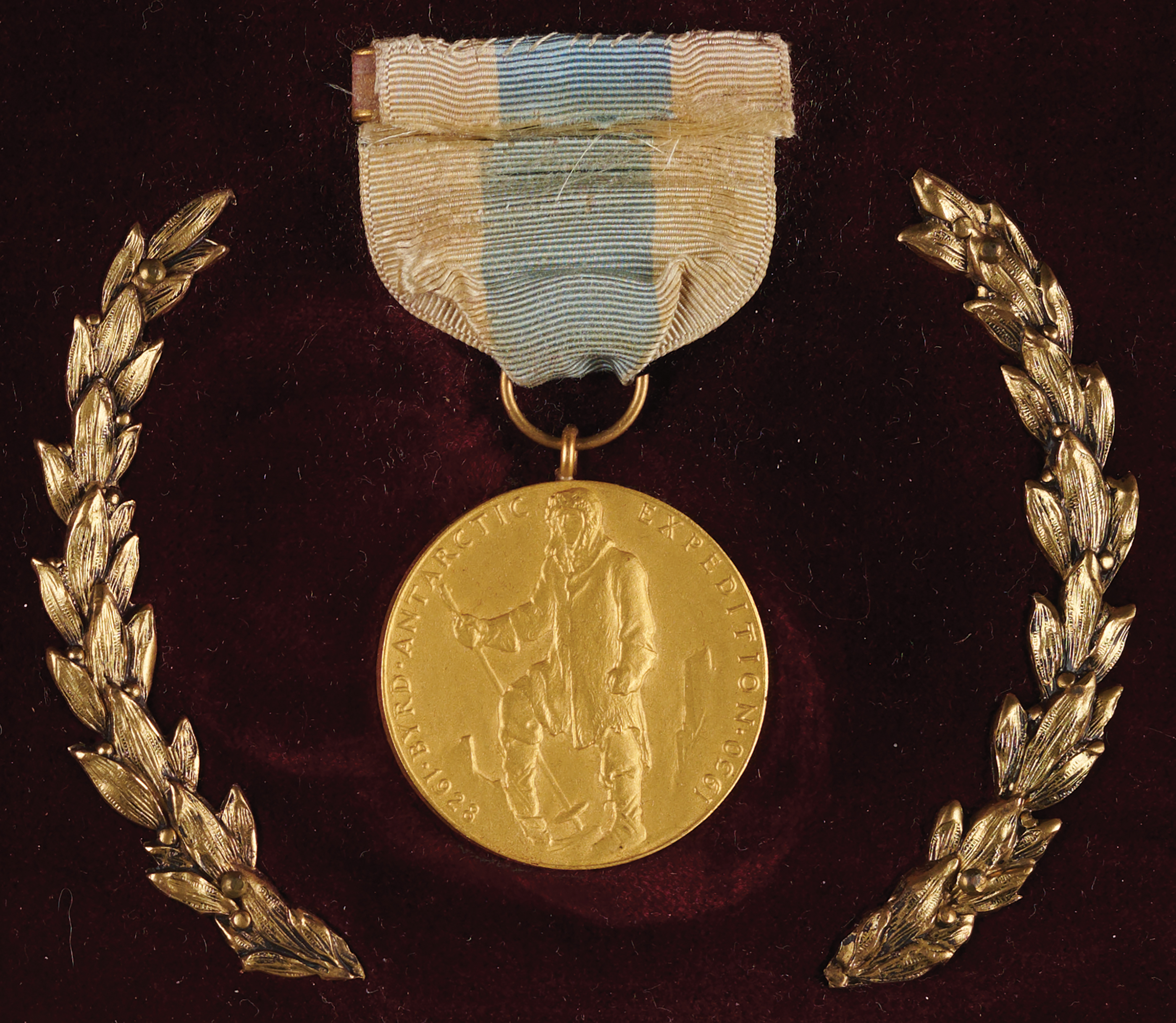
Exceptionally rare Congressional Gold Medal from the Byrd Antarctic Expedition presented to George Hamilton Black, a supply officer on Richard E. Byrd’s famed Antarctic Expedition of 1928–1930. The medal, 1.25˝ in diameter, bears an embossed front design of Admiral Byrd in fur-lined arctic clothing encircled with text: “Byrd Antarctic Expedition 1928-1930.” The edge is engraved “G. Hamilton Black,” and the medal is suspended from a white silk ribbon with a light blue center stripe. The reverse (hidden due to framing) features the sailing ship City of New York, surrounded by dedication text: ‘Presented to the Officers and Men of the Byrd Antarctic Expedition to Express the High Admiration In Which the Congress and the American People Hold Their Heroic and Undaunted Services in Connection With the Scientific Investigation Exploration of the Antarctic Continent.’
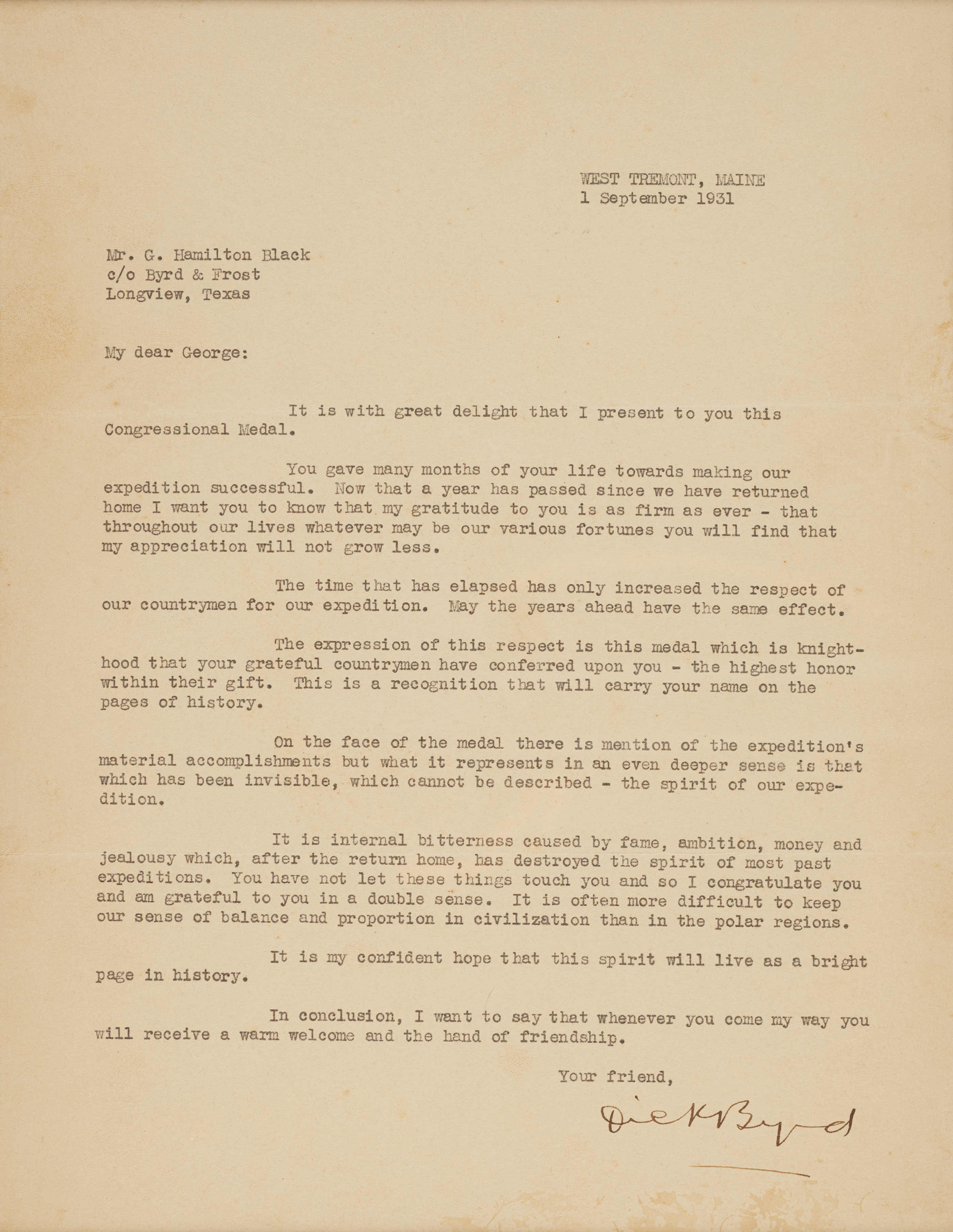
The medal is presented with its original transmittal TLS from Admiral Byrd, signed “Dick Byrd,” one page, 8.25 x 10.75, September 1, 1931. Addressed from West Tremont, Maine, the letter reads, in full: “It is with great delight that I present to you this Congressional Medal. You gave many months of your life towards making our expedition successful. Now that a year has passed since we have returned home I want you to know that my gratitude to you is as firm as ever — that throughout our lives whatever may be our various fortunes you will find that my appreciation will not grow less. The time that has elapsed has only increased the respect of our countrymen for our expedition. May the years ahead have the same effect.
The expression of this respect is this medal which is knighthood that your grateful countrymen have conferred upon you — the highest honor within their gift. This is a recognition that will carry your name on the pages of history. On the face of the medal there is mention of the expedition's material accomplishments but what it represents in an even deeper sense is that which has been invisible, which cannot be described — the spirit of our expedition.
It is internal bitterness caused by fame, ambition, money and jealousy which, after the return home, has destroyed the spirit of most past expeditions. You have not let these things touch you and so I congratulate you and am grateful to you in a double sense. It is often more difficult to keep our sense of balance and proportion in civilization than in the polar regions. It is my confident hope that this spirit will live as a bright page in history. In conclusion, I want to say that whenever you come my way you will receive a warm welcome and the hand of friendship.” Matted together with an engraved plate within its original frame to an overall size of 14 x 21. In overall very good to fine condition.
On May 23, 1930, President Herbert Hoover signed legislation enacted by the 71st Congress (1929–1931) authorizing the award of Congressional Gold, Silver, and Bronze Medals—among the highest honors bestowed by the United States Congress—to members of Rear Admiral Richard E. Byrd’s first Antarctic expedition. Byrd, already renowned for his pioneering Arctic flights, led the expedition to Antarctica in December 1928, where the team established their base—dubbed ‘Little America’—on the Ross Ice Shelf and from which Byrd made the historic first flight over the South Pole in November 1929.
Over the course of two years, the explorers endured the extreme conditions of the Antarctic while conducting extensive scientific work. Using aircraft for aerial surveys, the expedition mapped more than 150,000 square miles of previously uncharted territory and gathered valuable geological and meteorological data. The perilous nature of Byrd’s polar explorations and the scientific knowledge gained from them led Representative Clarence McLeod of Michigan to describe the achievement as among ‘the wonders of our age.’
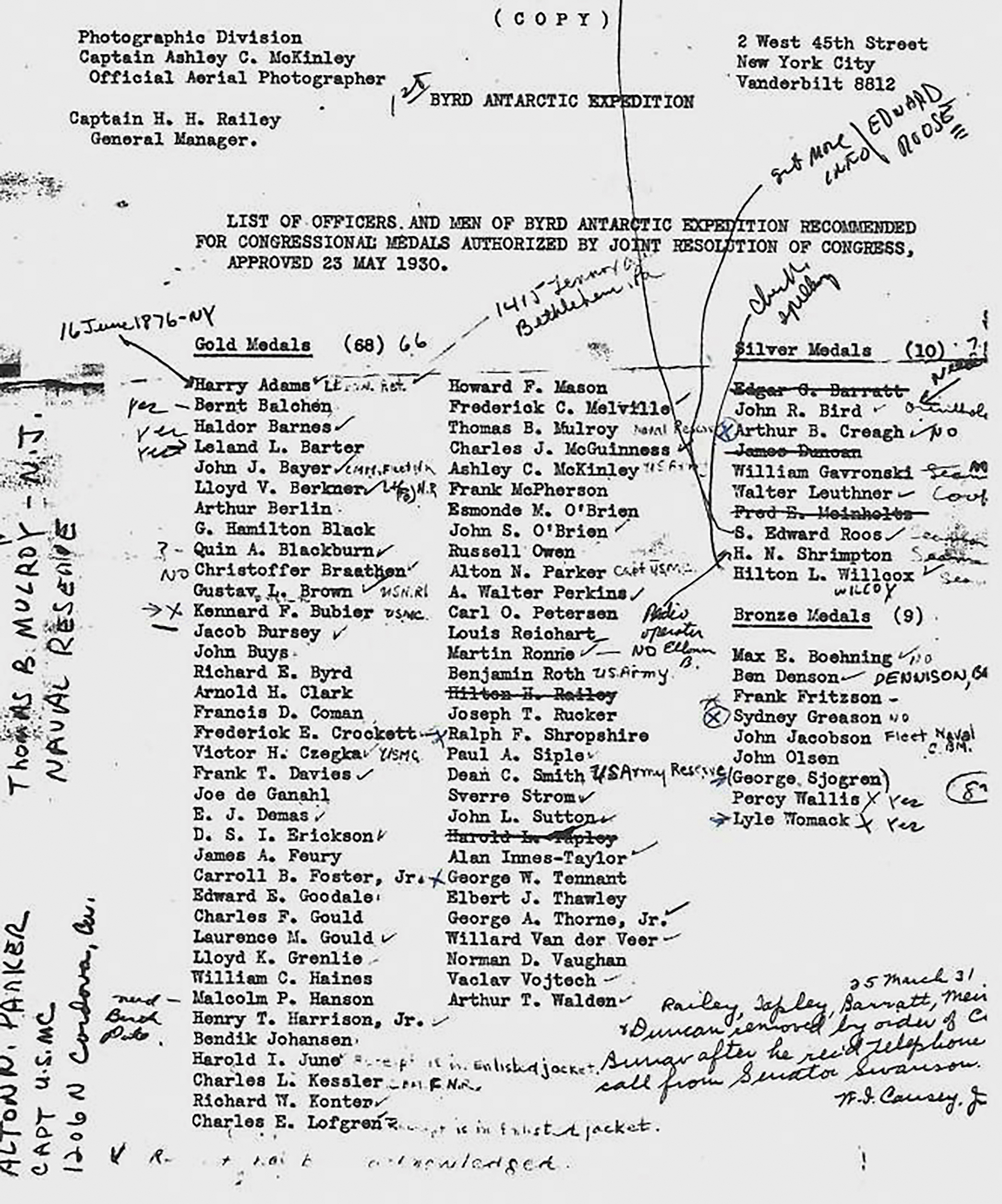
Following congressional authorization, the Navy Department organized a competition to design the medal. Francis H. Packer of New York was awarded the $1,000 prize when the Commission of Fine Arts selected his design from among 16 submissions. The medal measures 1.25 inches in diameter and was struck in gold, silver, and bronze. A total of 81 medals were produced at a cost of $6,560 — 65 in gold, seven in silver, and nine in bronze — and were awarded to members and key participants of the expedition. A modern printed copy of the original list of medal recipients is included, with Black’s name (“G. Hamilton Black”) present in the “Gold Medals” column.
Accompanied by various photographs, documents, and certificates related to Black’s career (one bearing a facsimile signature of President Lyndon B. Johnson), his vintage Amrita Grotto fez, and a presentation board containing an image of Black and an impressive set of 13 military pins and medals.
George Hamilton Black (1896–1965) was a merchant seaman and a decorated combat veteran of three wars whose career combined military service with polar exploration. A retired Army sergeant, he served in World War I, World War II, and the Korean War, earning numerous decorations for valor. During World War I, he fought with the Navy and received the Navy Cross for heroism in a sea battle off the coast of Ireland. Later, before the United States entered World War II, he served as a Canadian infantryman and was awarded the British Distinguished Service Cross for destroying a German machine-gun nest near Dieppe. His other honors included the Silver Star and Bronze Star.
Beyond his combat record, Black was closely associated with the famed explorer Rear Adm. Richard E. Byrd. He served as Byrd’s supply officer on two polar expeditions in the 1920s, joining the 1926 Arctic expedition during which Byrd and pilot Floyd Bennett attempted their flight over the North Pole. Black was stationed in an Arctic archipelago supporting the mission. Two years later, he accompanied Byrd to Antarctica, where he was temporarily stranded in a blizzard miles from the expedition’s base at Little America. Despite the extreme conditions and hardships faced by the party, the expedition succeeded, and after months in the polar wilderness the team safely returned home, marking a notable chapter in early American polar exploration.