The 30 Minute Rule begins April 23 at 7:00 PM EDT. An Initial Bid Must Be Placed By April 23 at 6:00 PM EDT To Participate After 6:00 PM EDT
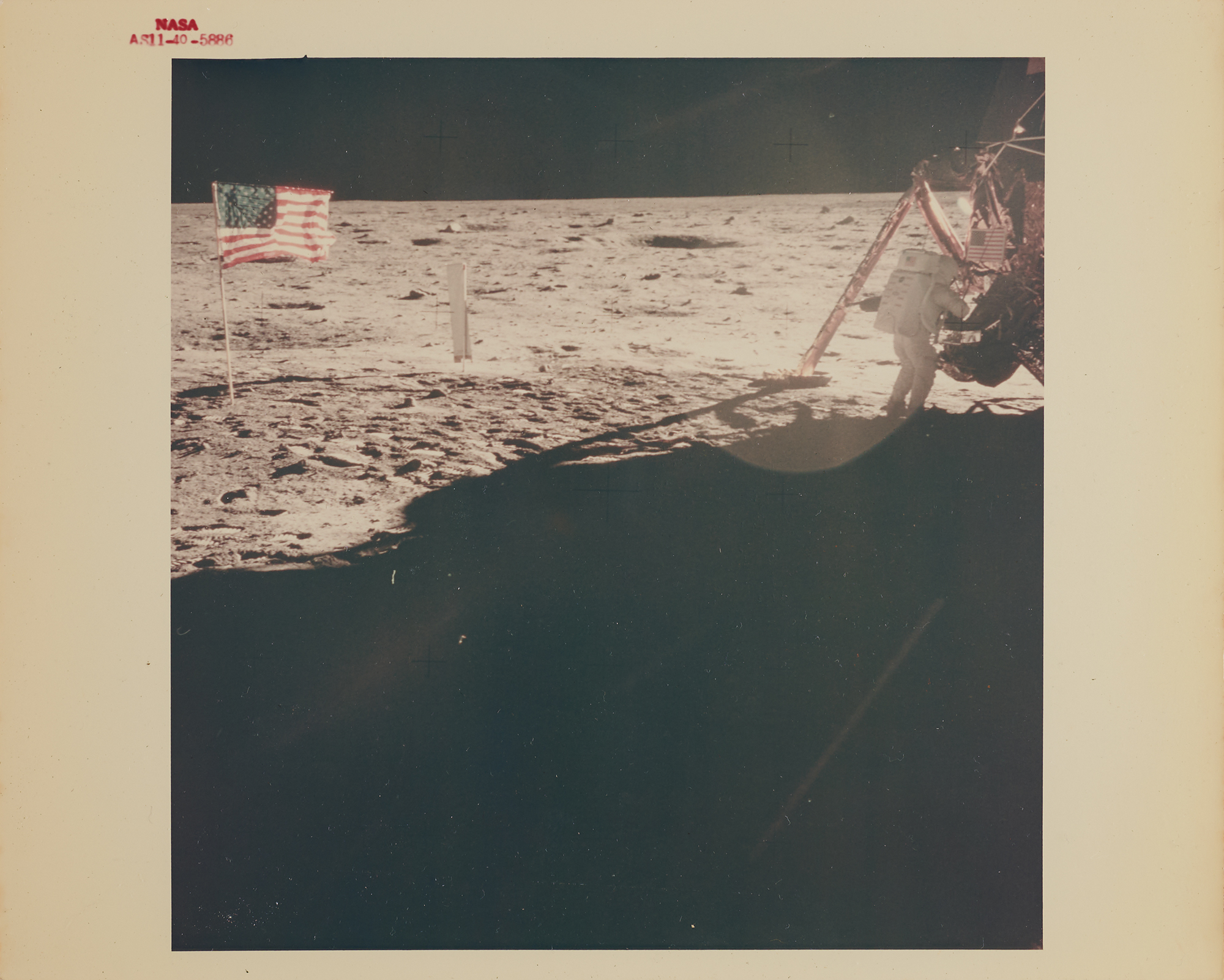
Exceedingly rare original 'Type 1' vintage color glossy 10 x 8 red-numbered NASA photo (AS11-40-5886) showing Neil Armstrong on the right—packing a lunar sample into an open rockbox at the MESA (Modular Stowage Equipment Assembly)—and the deployed flag of the United States on the left. Also visible are the Solar Wind Collector and a strut of the Lunar Module Eagle, which casts a dramatic shadow across the lunar surface in the foreground. Reverse bears "A Kodak Paper" watermarks. In fine condition, with a tiny emulsion blemish in the shadow, and a light paperclip impression to the right edge.
This photograph occupies a singular place in the visual record of the Apollo 11 mission: it is the only known photograph of Apollo 11 commander Neil Armstrong on the lunar surface.
Though Armstrong became the first human being to set foot on another world on July 20, 1969, he was almost always positioned behind the camera during the moonwalk. For nearly two decades, it was widely believed that no high-resolution still photograph existed of Armstrong on the moon. The only known images of him were grainy video frames from the Westinghouse television camera and fleeting exposures from the 16mm Maurer motion picture camera.
That belief changed in 1987, when researchers carefully reviewing mission records and frame sequences identified this image within Buzz Aldrin’s panoramic series taken from the rim of Double Crater. Captured in stark lunar light, Armstrong appears in full profile, methodically stowing precious lunar samples—an unguarded working moment of the first man on the moon, preserved in crisp 70mm detail. No other still Hasselblad photograph documents him on the lunar surface in this way.
Remarkably, this frame was not selected for general release by NASA’s Public Affairs Office in 1969. As a result, it remained largely unpublished and unseen for decades. Very few vintage red-numbered prints are known to survive, making this not only one of the most historically significant images of the Apollo program, but also one of the most elusive.