The 30 Minute Rule begins April 15 at 7:00 PM EDT. An Initial Bid Must Be Placed By April 15 at 6:00 PM EDT To Participate After 6:00 PM EDT
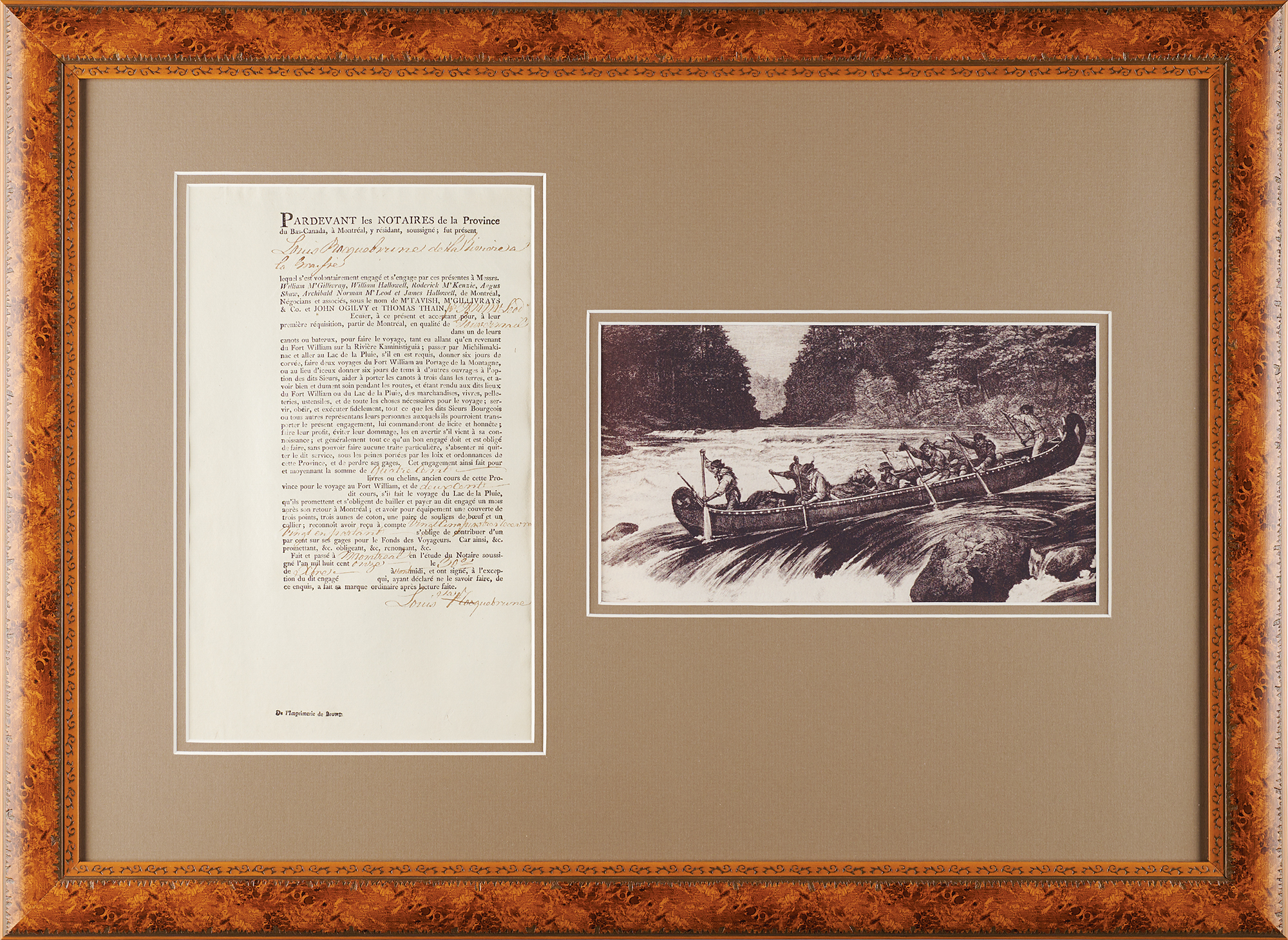
Partly-printed DS in French, one page, 7.25 x 11.75, October 30, 1811. Contract in which Louis Rocquebrune is engaged by the firm McTavish, McGillivray & Co. and their associates, John Ogilvy and Thomas Thain, "to make the journey both to and from Fort William on the River Kaministiguia; pass through Michilimakinac and go to the Rain Lake, if he is so required to do, give six days of statute labor, make two journeys from Fort William to the Portage de la Montagne, or instead of these give six days of time to other works at the option of the said Gentlemen, help to carry the three-man boats on land, and take due and good care during the journeys, and on arrival at…Fort William and Rain Lake, of the merchandise, provisions, skins, utensils and all the articles necessary for the journey; serve, obey and faithfully execute the orders of all the Gentlemen or all others representing their persons."
Rocquebrune will be paid 400 livres for the journey to Fort William and an additional 200 livres for the journey to Rain Lake, payable a month after his return to Montreal. Signed by Rocquebrune with his mark, an "X," over his name, written in another hand, at the conclusion of the document. Double-matted and framed with an image of the Voyageurs to an overall size of 27 x 20. In fine condition.
The Voyageurs were the often colorful, largely unnamed canoe men who formed the backbone of the Canadian fur trade in the 18th and early 19th centuries. Employed by powerful firms such as McTavish, McGillivray & Co.—which were associated with the North West Company and later the Hudson’s Bay Company—they transported trade goods deep into the Canadian wilderness and returned with furs destined for European markets. Unlike the earlier independent coureurs des bois, who traded directly with Indigenous peoples near settlements or ventured inland on their own initiative, the Voyageurs operated under a regulated permit system established by French authorities in the late 17th century. As employees of expanding fur companies, they followed established canoe routes, notably from Montreal to Fort William on Lake Superior, a key staging point for western trade networks.
Renowned for their strength and endurance, Voyageurs paddled birchbark canoes up to 14 hours a day at a steady pace, often beginning before dawn. They carried enormous loads—typically two 90-pound bundles of fur, sometimes more—across long portages, with distance measured in “pipes,” or the time between smoking breaks. Singing accompanied their labor, echoing across waterways, though few of their songs survive today. For more than a century they were essential to the success of the fur trade, but declining fur demand, depleted animal populations, and advances in transportation—especially the completion of the Canadian Pacific Railway in the late 1880s—brought their era to an end. As a result, documents and artifacts relating to the Voyageurs are now exceedingly rare.