
The 30 Minute Rule begins April 15 at 7:00 PM EDT. An Initial Bid Must Be Placed By April 15 at 6:00 PM EDT To Participate After 6:00 PM EDT
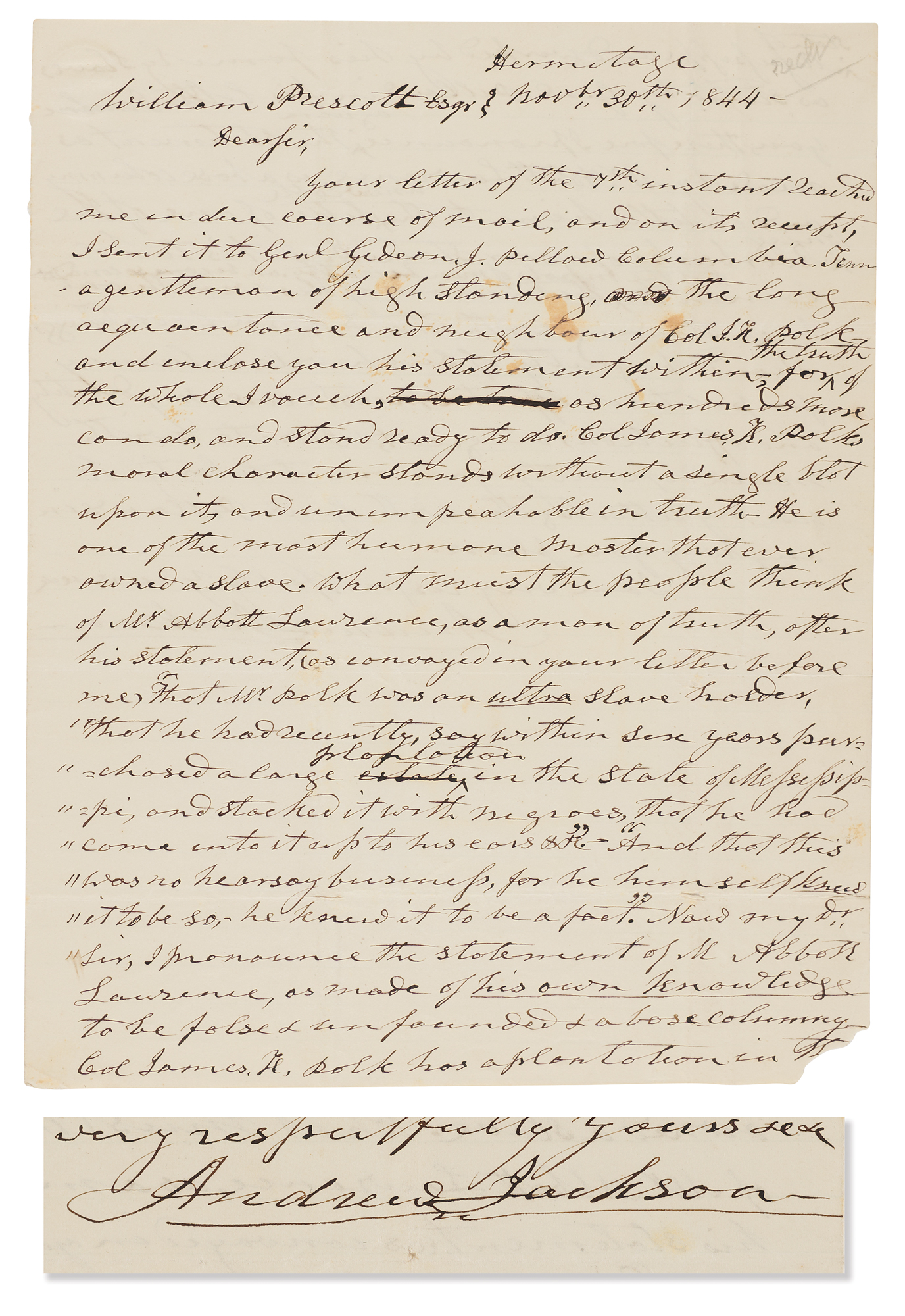
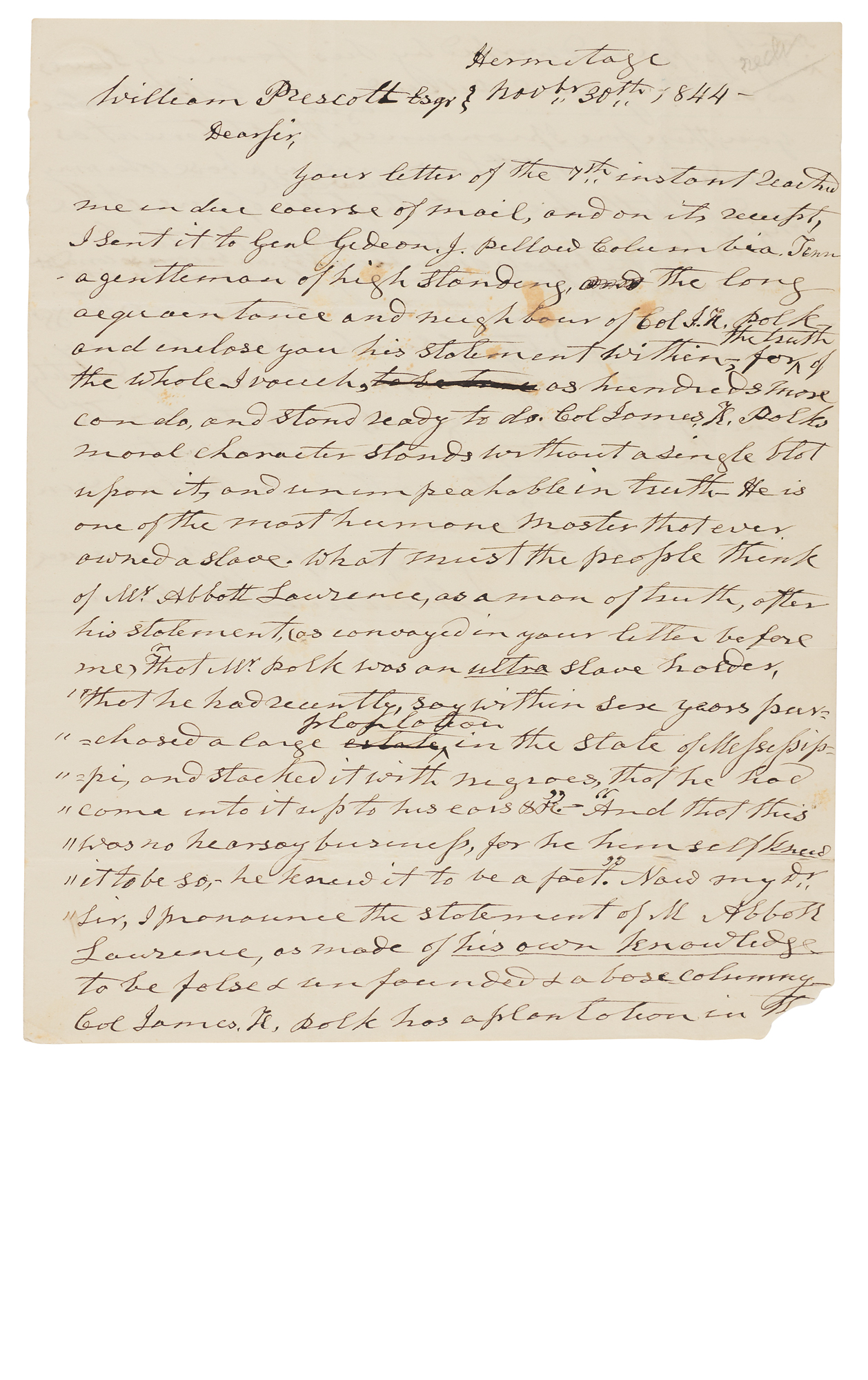
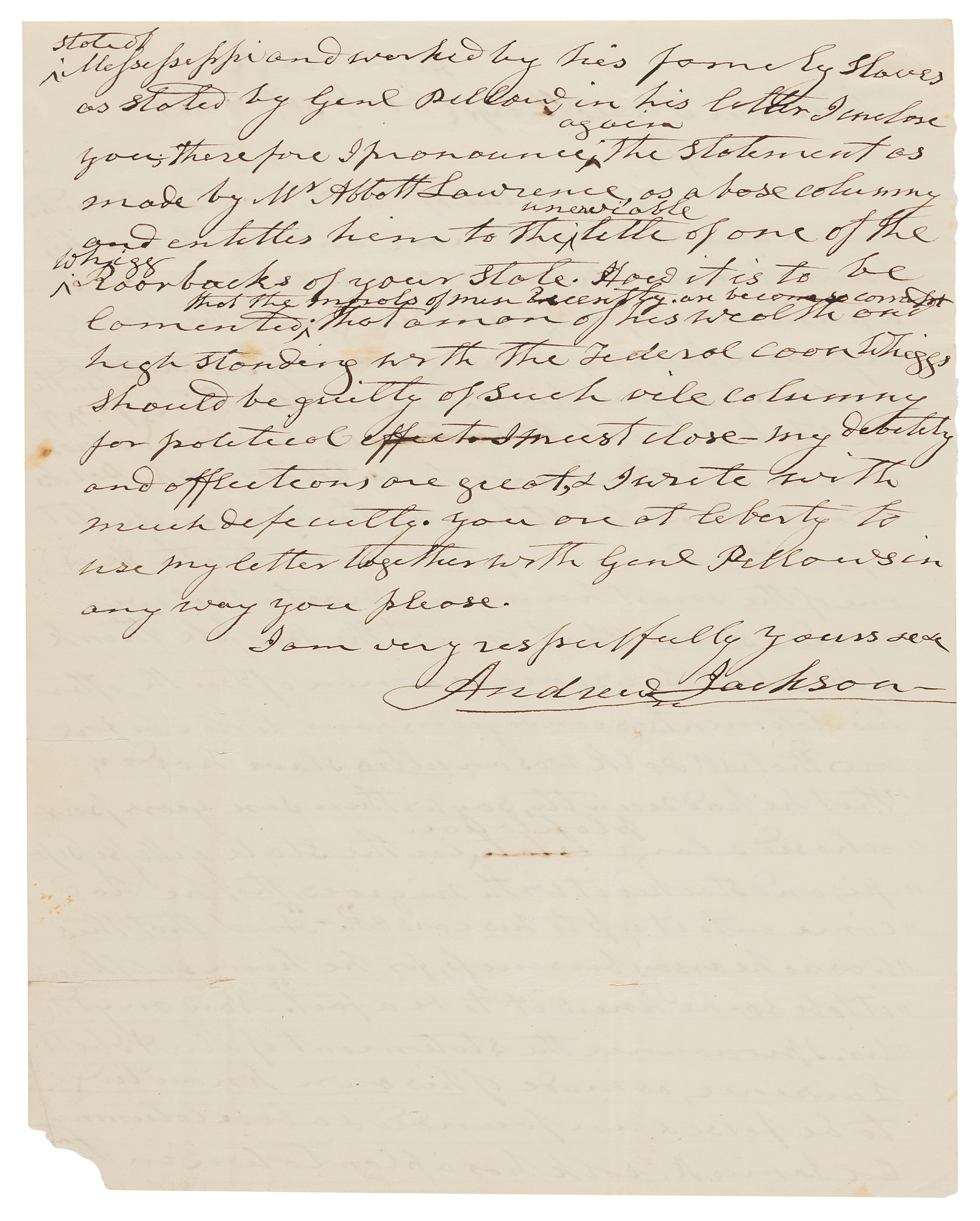
ALS, one page both sides, 7.5 x 9.75, November 30, 1844. Handwritten letter to American historian William Prescott, in full: "Your letter of the 7th instant reached me under course of mail, and on its receipt, I sent it to Gen'l Gideon J. Pillow, Columbia Tenn. a gentleman of high standing, of long acquaintance and neighbour of Col. J. K. Polk and enclose you his statement within, for the truth of the whole I vouch, as hundreds more can do, and stand ready to do. Col. James K. Polk's moral character stands without a single blot upon it, and unimpeachable in truth. He is one of the most humane Masters that ever owned a slave. What must the people think of Mr. Abbott Lawrence, as a man of truth, after his statement, (as conveyed in your letter before me) that Mr. Polk was an ultra slave holder, that he had recently, say within six years purchased a large plantation in the state of Mississippi, and stacked it with negroes, that he had come into it up to his ears &c. And that this was no hearsay business, for he himself knew it to be so, he knew it to be a fact.
Now my Dr. Sir, I pronounce the statement of Mr. Abbott Lawrence, as made of his own knowledge to be false & unfounded & a base calumny. Col. James K. Polk has a plantation in the State of Mississippi and worked by his family slaves as stated by Gen'l Pillow in his letter I enclose you, therefore I pronounce again the statement as made by Mr. Abbott Lawrence as a base calumny and entitles him to the unenviable title of one of the Whigg Roorbacks of your state. How is it to be lamented that the morals of men recently are become so corrupt, that a man of his wealth and a high standing with the Federal Coon Whiggs should be guilty of such vile calumny for political effect. I must close-my debility and afflictions are great, & I write with much difficulty. You are at liberty to use my letter together with Genl Pillows in any way you please." In fine condition, with small stains and trivial corner loss.
At the 1844 Democratic National Convention, James K. Polk—a lifelong supporter of Andrew Jackson—was nominated on the ninth ballot, defeating former president Martin Van Buren, whose opposition to the annexation of Texas cost him crucial support. The presidential campaign that followed was marked by sharp personal attacks. Democrats portrayed Whig candidate Henry Clay as a gambler and drunkard, and as an opportunistic seeker of the nation’s highest office. In turn, the Whigs attacked Polk as a mere puppet of Andrew Jackson and criticized him as a coward for once declining to participate in a duel. Polk’s steadfast loyalty to Jackson throughout his controversial career earned him the nickname 'Young Hickory.' In the general election, held in most states on November 12, 1844, Polk emerged victorious, carrying fifteen states in the Electoral College.
Abbott Lawrence (1792-1855), whose statements Jackson considered to be "a base calumny," was a merchant and statesman who founded and developed Lawrence, Massachusetts. An ardent Whig, he represented his district in Congress from 1834 to 1836 and 1838 to 1840 and attended the national convention in 1844 as a delegate. In 1848 he was a leading candidate for the vice-presidential nomination.
General Gideon John Pillow (1806–1878), to whom Jackson forwarded Prescott's letter, was a criminal lawyer in Columbia, Tennessee, who had fought for the Confederacy during the Civil War and was Polk's partner for some time. He claimed for himself the major responsibility for the nomination of Polk for the Presidency in 1844.
The term "Roorbach," a political canard (especially one that backfires), arose in the campaign of 1844, when the Ithaca (New York) Chronicle printed some alleged extracts from an imaginary book entitled Roorback's Tour Through the Western and Southern States containing grotesque charges against Polk, which were promptly copied by other Whig newspapers.

This item is Pre-Certified by PSA/DNA
Buy a third-party letter of authenticity for
$150.00
*This item has been pre-certified by a trusted third-party authentication service, and by placing a bid on this item, you agree to accept the opinion of this authentication service. If you wish to have an opinion rendered by a different authenticator of your choosing, you must do so prior to your placing of any bid. RR Auction is not responsible for differing opinions submitted 30 days after the date of the sale.