The 30 Minute Rule begins April 15 at 7:00 PM EDT. An Initial Bid Must Be Placed By April 15 at 6:00 PM EDT To Participate After 6:00 PM EDT
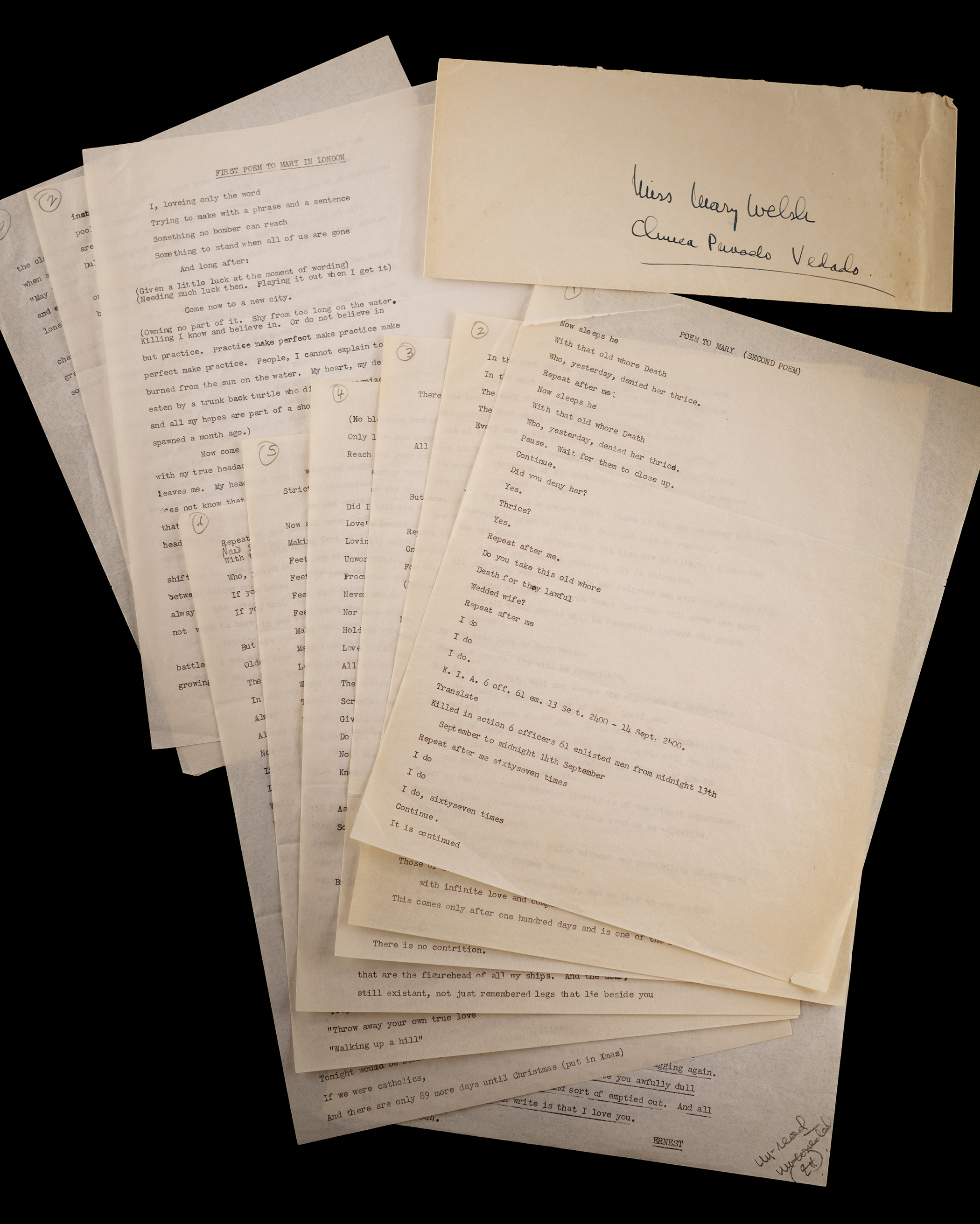
Two typewritten poetical manuscripts by Ernest Hemingway, totaling ten pages, 8.5 x 11, Ritz Hotel, Paris, September 1944. The second poem is signed in pencil on page 7, "un-read, un-corrected, E.H.," and bears additions written by Hemingway on pages 2 and 6.
The first is headed "First Poem to Mary in London," and begins: "I, loveing only the word / Trying to make with a phrase and a sentence / Something no bomber can reach / Something to stand when all of us are gone / And long after: / (Given a little luck at the moment of wording) / (Needing much luck then. Playing it out when I get it) / Come now to a new city."
The second is headed "Poem to Mary (Second Poem)," and begins: "Now sleeps he / With that old whore Death / Who, yesterday, denied her thrice. / Repeat after me / Now sleeps he / With that old whore Death / Who, yesterday, denied her thrice." On the last page, Hemingway closes with a typed letter: "So, Mary, now I love you straight and true and send you this to let you know that we had a rather sticky day today in the forest. Casualties were fairly heavy, and a certain amount of battle fatigue. Many more than there should be. But there are many contributing factors. I'm getting sort of mixed up on a lot of things again. But much clearer on others. Very hard to write about this stuff. It is different from the boat. In the boat we were always waiting for it. Here it is the happening all the time and who it happens to. I do not think about me at all any more. Bragging again. I think about you and that brings me in. I write you awfully dull letters darling, because I get tired and sort of emptied out. And all I have to tell you that I can write is that I love you."
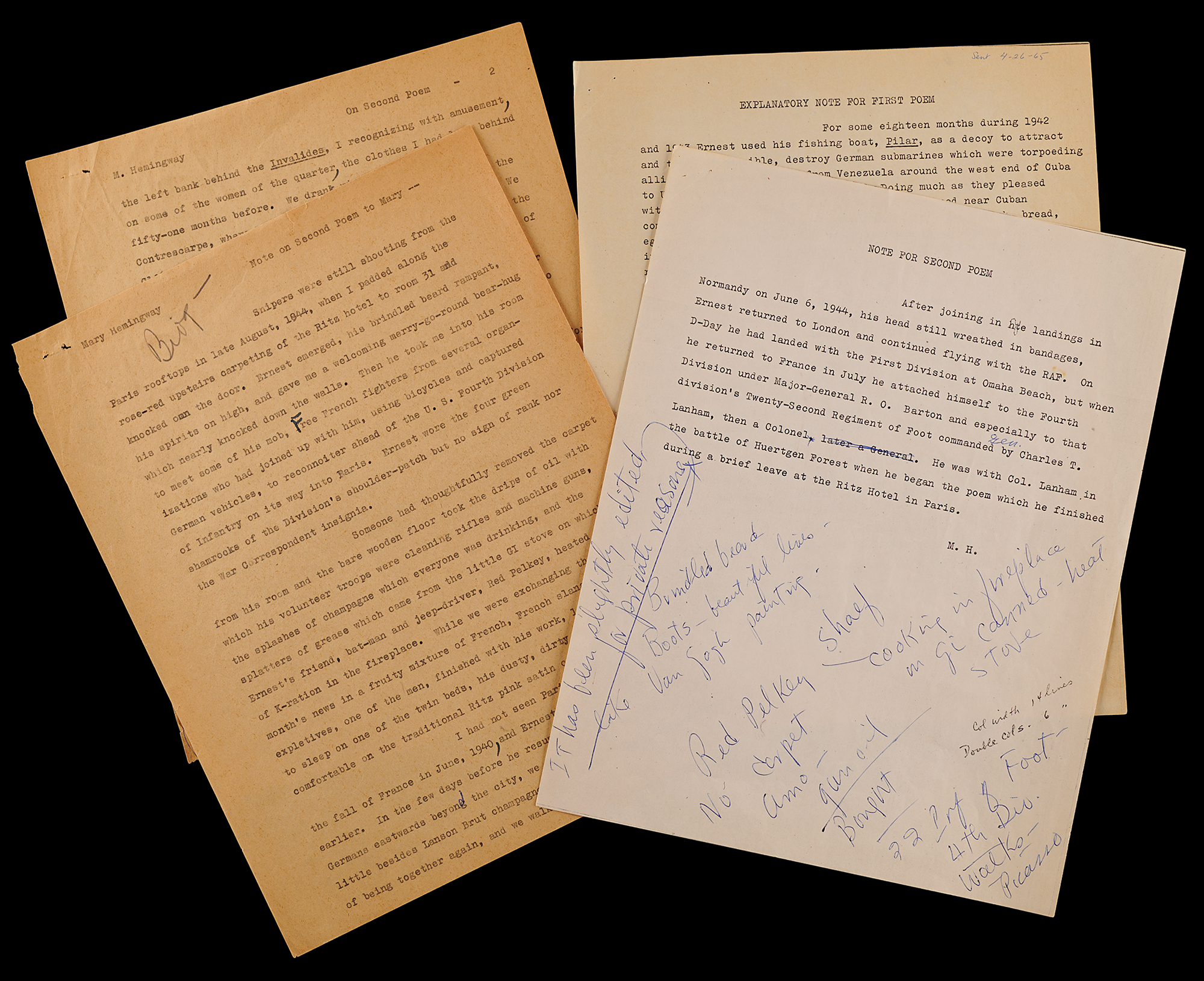
Includes the original envelope, addressed in Hemingway's hand to "Miss Mary Welsh." Also includes three of Mary Hemingway's explanations of the poems (original photocopies and carbon typescript with her handwritten revisions), totaling four pages, evidently prepared as part of the creation of the LP 'Ernest Hemingway – Reading,' released by Caedmon Records in 1965. On it, Hemingway reads 'Second Poem To Mary.'
Mrs. Hemingway relates: "After joining in the landings in Normandy on June 6, 1944, his head still wreathed in bandages, Ernest returned to London and continued flying with the RAF. On D-Day he had landed with the First Division at Omaha Beach, but when he returned to France in July he attached himself to the Fourth Division under Major-General R. O. Barton and especially to that division's Twenty-Second Regiment of Foot commanded by Gen. Charles T. Lanham, then a Colonel. He was with Col. Lanham in the battle of Huertgen Forest when he began the poem which he finished during a brief leave at the Ritz Hotel in Paris."
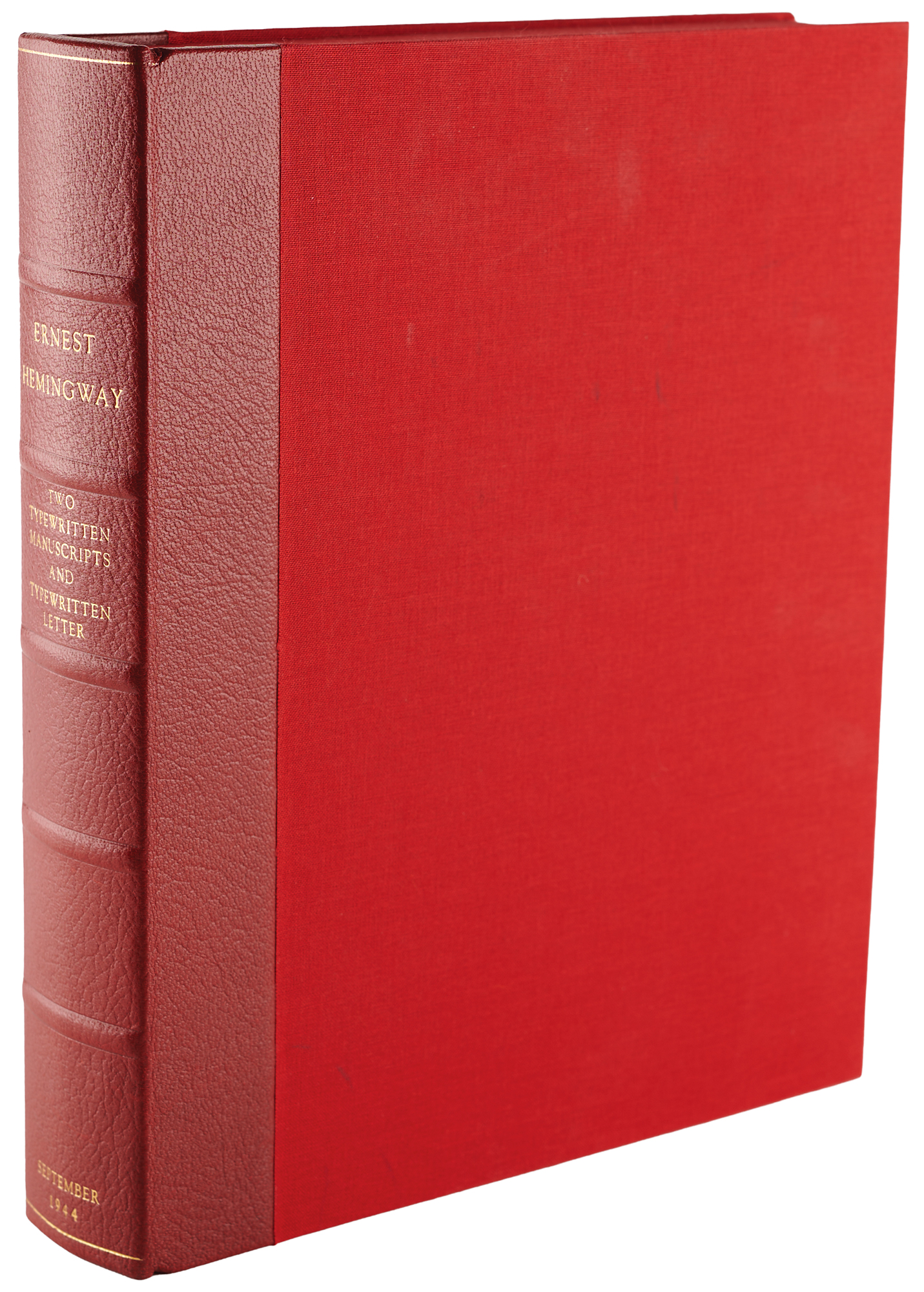
Housed in a handsome custom-made quarter-leather clamshell case. In overall very good to fine condition.
These wartime poems—written during one of the most intense periods of Hemingway’s life as a correspondent accompanying Allied troops in Europe—offer a rare and deeply personal glimpse into his emotional and psychological state in the closing months of World War II in Europe. The first poem blends reflections on language, war, and displacement, juxtaposing the permanence of words with the destruction of modern warfare. It continues with commentary on his anti-submarine patrols off the Cuban coast with Winston Guest ("Wolfie") amid meditations on fatigue, comradeship, and the dislocation of a man removed from the sea.
The second poem is darker and experimental in structure, incorporating liturgical repetition and military language to confront the realities of death in combat. Referencing casualties and the bureaucratic language of wartime reporting, Hemingway constructs a grim, ironic meditation on mortality and sacrifice. Throughout both works, moments of tenderness and longing for Mary Welsh appear amid the brutal imagery of war—an emotional anchor for him during a turbulent period.
Mary Hemingway’s accompanying notes place the poems within the context of Hemingway’s wartime activities, capturing Hemingway at the intersection of love and violence. Manuscript material relating to Hemingway’s wartime experiences is exceedingly scarce, and literary manuscripts of his poetry are rarer still. The present group, combining two substantial poems, minor autograph corrections, a signed notation, a heartfelt letter, and contextual material from Mary Hemingway herself, represents an exceptional and intimate survival from a dramatic chapter of Hemingway’s life.