The 30 Minute Rule begins April 15 at 7:00 PM EDT. An Initial Bid Must Be Placed By April 15 at 6:00 PM EDT To Participate After 6:00 PM EDT
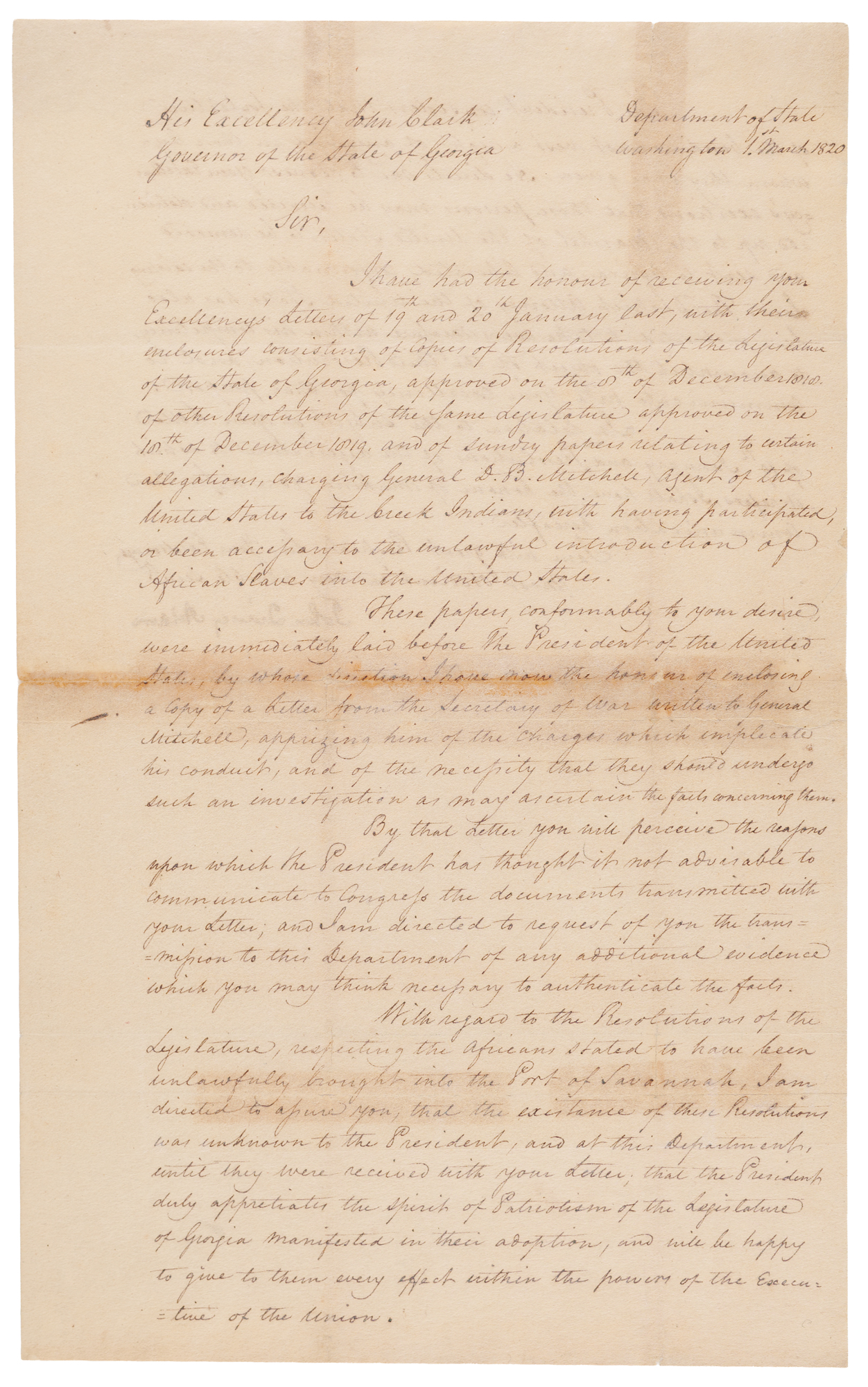
LS as secretary of state, one page, both sides, 8 x 13, March 1, 1820. Addressed from the “Department of State” in Washington, a letter to John Clark, governor of Georgia, acknowledging receipt of Clark's letters of January 19 and 20 with their enclosures: copies of resolutions of the Georgia Legislature approved December 8, 1810, and December 10, 1819, together with sundry papers relating to allegations charging General D.B. Mitchell, U.S. Agent to the Creek Indians, with having participated in or been accessory to the unlawful introduction of African slaves into the United States.
Adams advises that the papers were immediately laid before President Monroe, who directed Adams to enclose a copy of a letter from the Secretary of War to General Mitchell apprising him of the charges implicating his conduct and of the necessity for investigation, and that the president thought it inadvisable to communicate the documents to Congress at this time. He requests transmission to the State Department of any additional evidence Clark may think necessary to authenticate the facts. Regarding the resolutions concerning Africans unlawfully brought into the Port of Savannah, states that the existence of those resolutions was unknown to the President and the Department until received with Clark's letter, that the President "duly appreciates the Spirit of Patriotism of the Legislature of Georgia manifested in their adoption," and will give them every effect within the powers of the Executive.
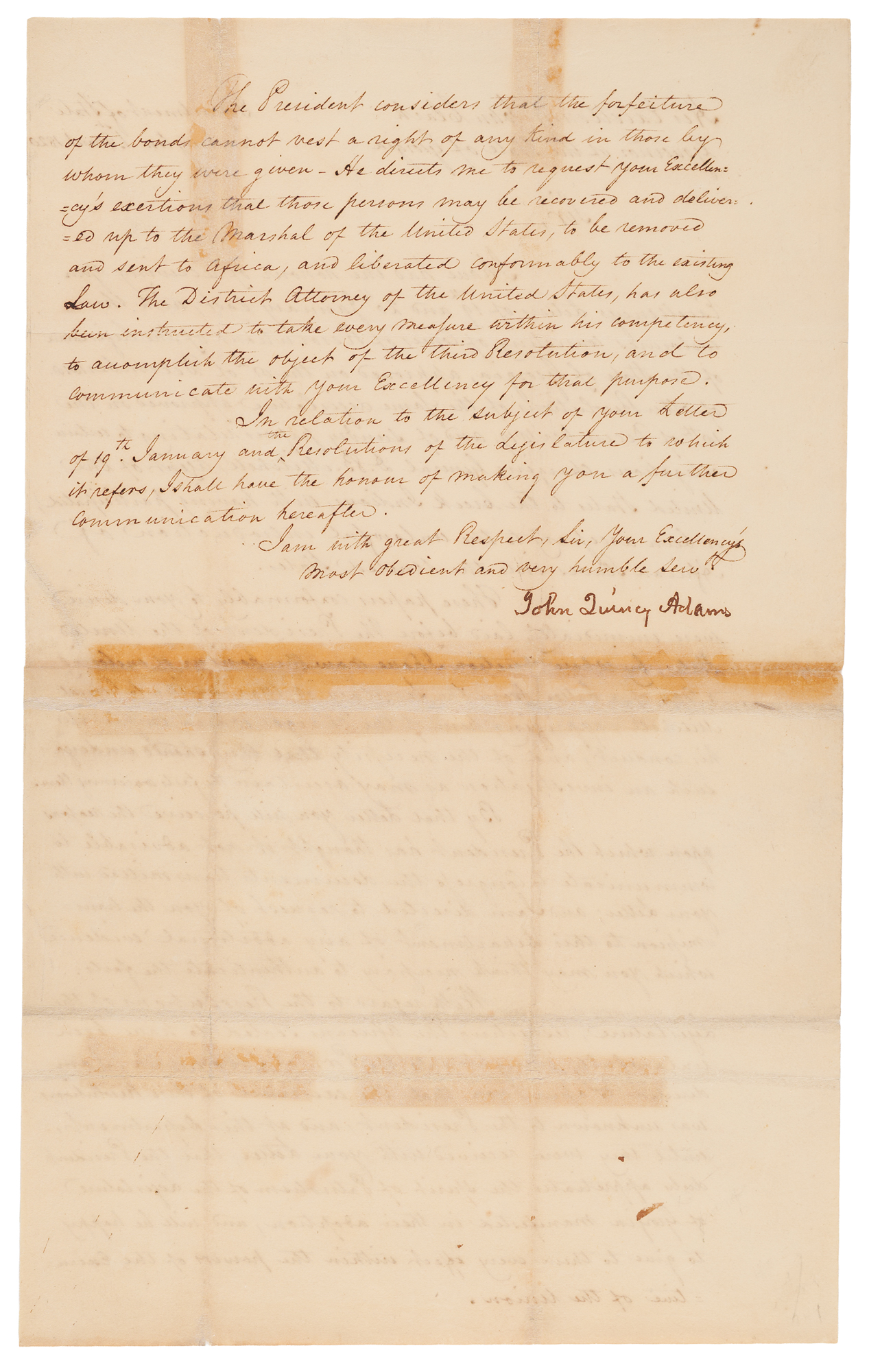
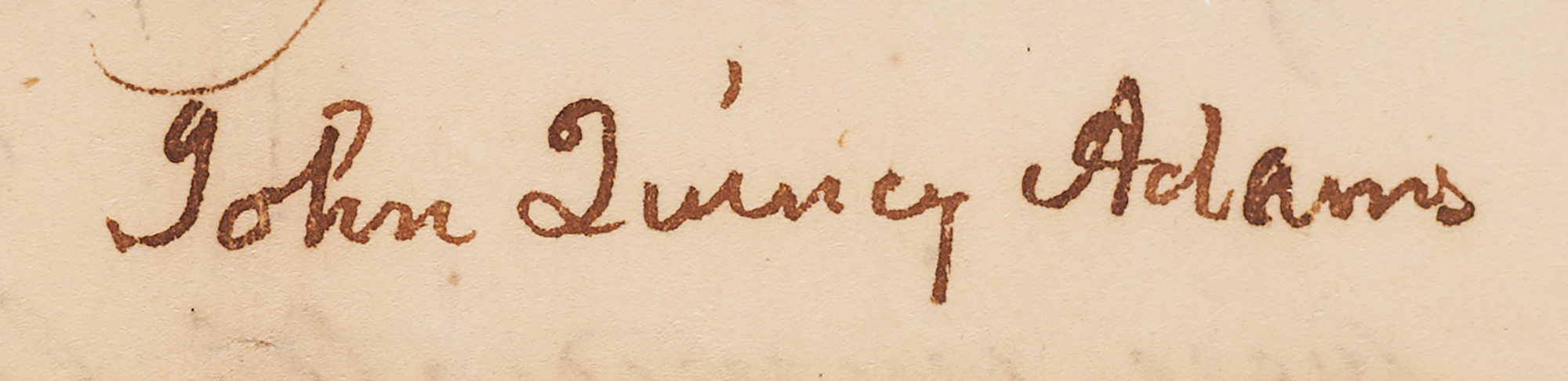
Adams continues: “The President considers that the forfeiture of the bonds cannot vest a right of any kind in those by whom they were given — He directs me to request Your Excellency's exertions that those persons may be recovered and delivered up to the Marshal of the United States, to be removed and sent to Africa, and liberated conformably to the existing Law.” He concludes by noting that the District Attorney has been instructed to take every measure within his competency to accomplish the object of the third Resolution, and promises a further communication on the subject of Clark's January 19 letter. In very good to fine condition, with old tape stains and discreet professional repairs.
David Brydie Mitchell (1766–1837) had served two terms as Governor of Georgia before President Madison appointed him U.S. Agent to the Creek Indians in 1817. Within months of his appointment, he became involved in a slave-smuggling ring operating out of Amelia Island, Florida, through which at least 110 Africans were illegally imported into the United States in violation of the Act of 1807 prohibiting the slave trade.
The contraband enslaved people were brought up the Flint River to Mitchell's agency, where they were divided among Mitchell and his business partners. The investigation was triggered when John Clark, who had just defeated Mitchell's political faction to win the governorship of Georgia in 1819, found incriminating correspondence in Mitchell's desk and forwarded it to Washington.
This letter, written fourteen months before Mitchell's formal dismissal, documents the early stage of Monroe's response: the President was unwilling to send the evidence to Congress, but directed that the Africans be located, transferred to federal custody, and repatriated under the provisions of the 1819 Slave Trade Act. Mitchell was ultimately dismissed in 1821 following a formal opinion by Attorney General William Wirt concluding that he had ‘prostituted his power as agent for Indian affairs…to the purpose of aiding and assisting in a conscious breach of the act of Congress of 1807.’ Adams would later, as president and then as a congressman, become one of the most forceful antislavery voices in American political life.

This item is Pre-Certified by PSA/DNA
Buy a third-party letter of authenticity for
$75.00
*This item has been pre-certified by a trusted third-party authentication service, and by placing a bid on this item, you agree to accept the opinion of this authentication service. If you wish to have an opinion rendered by a different authenticator of your choosing, you must do so prior to your placing of any bid. RR Auction is not responsible for differing opinions submitted 30 days after the date of the sale.