The 30 Minute Rule begins April 23 at 7:00 PM EDT. An Initial Bid Must Be Placed By April 23 at 6:00 PM EDT To Participate After 6:00 PM EDT
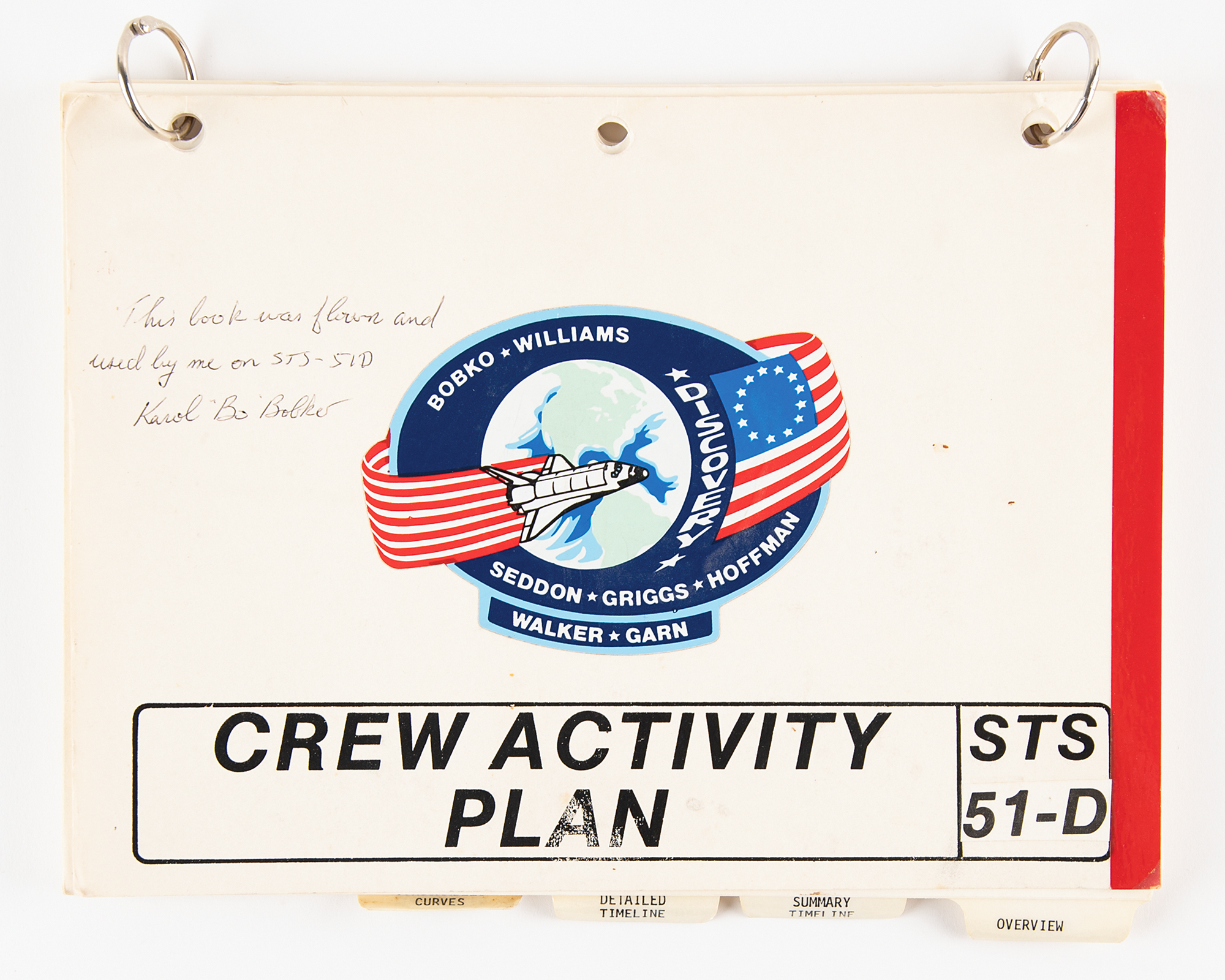
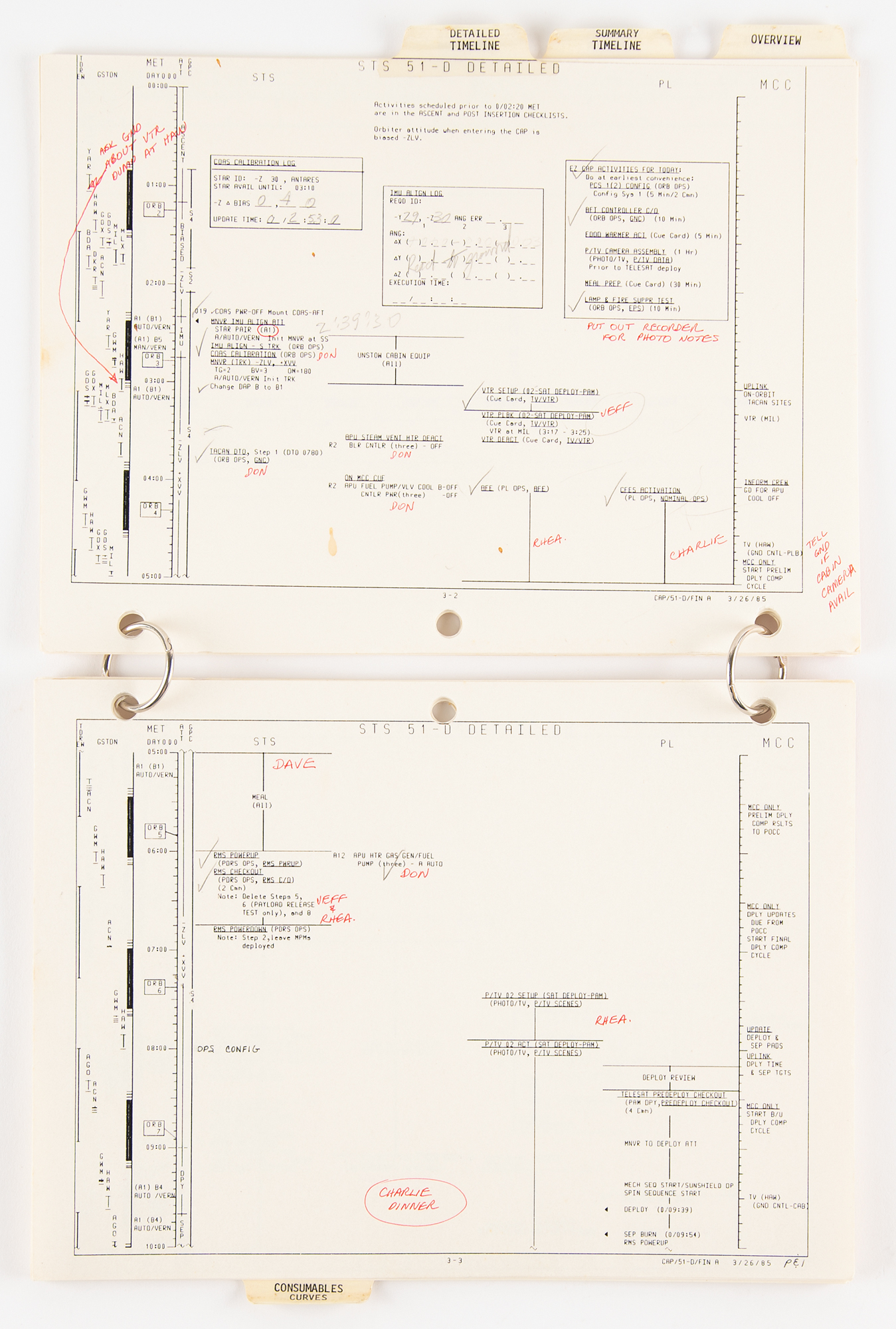
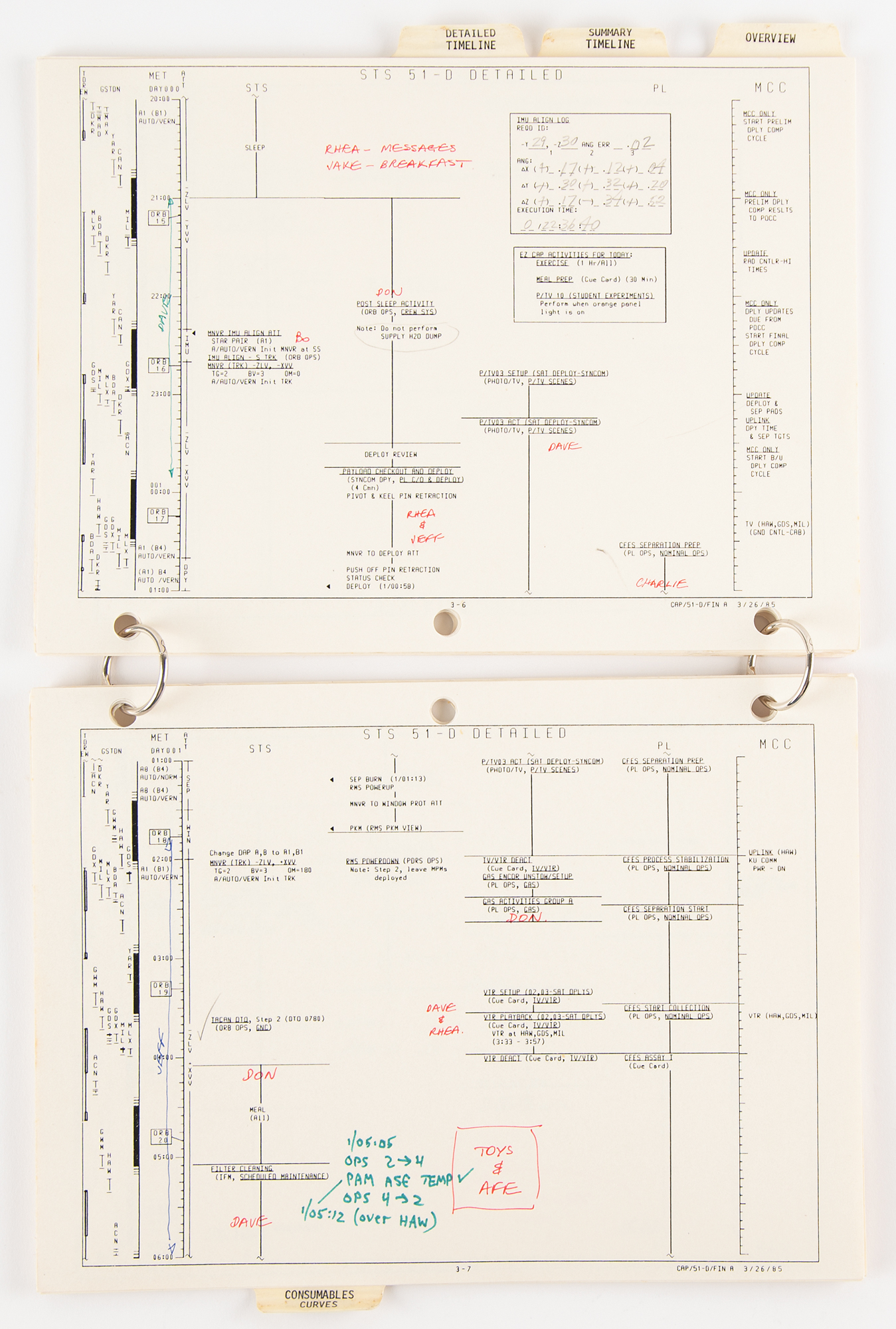
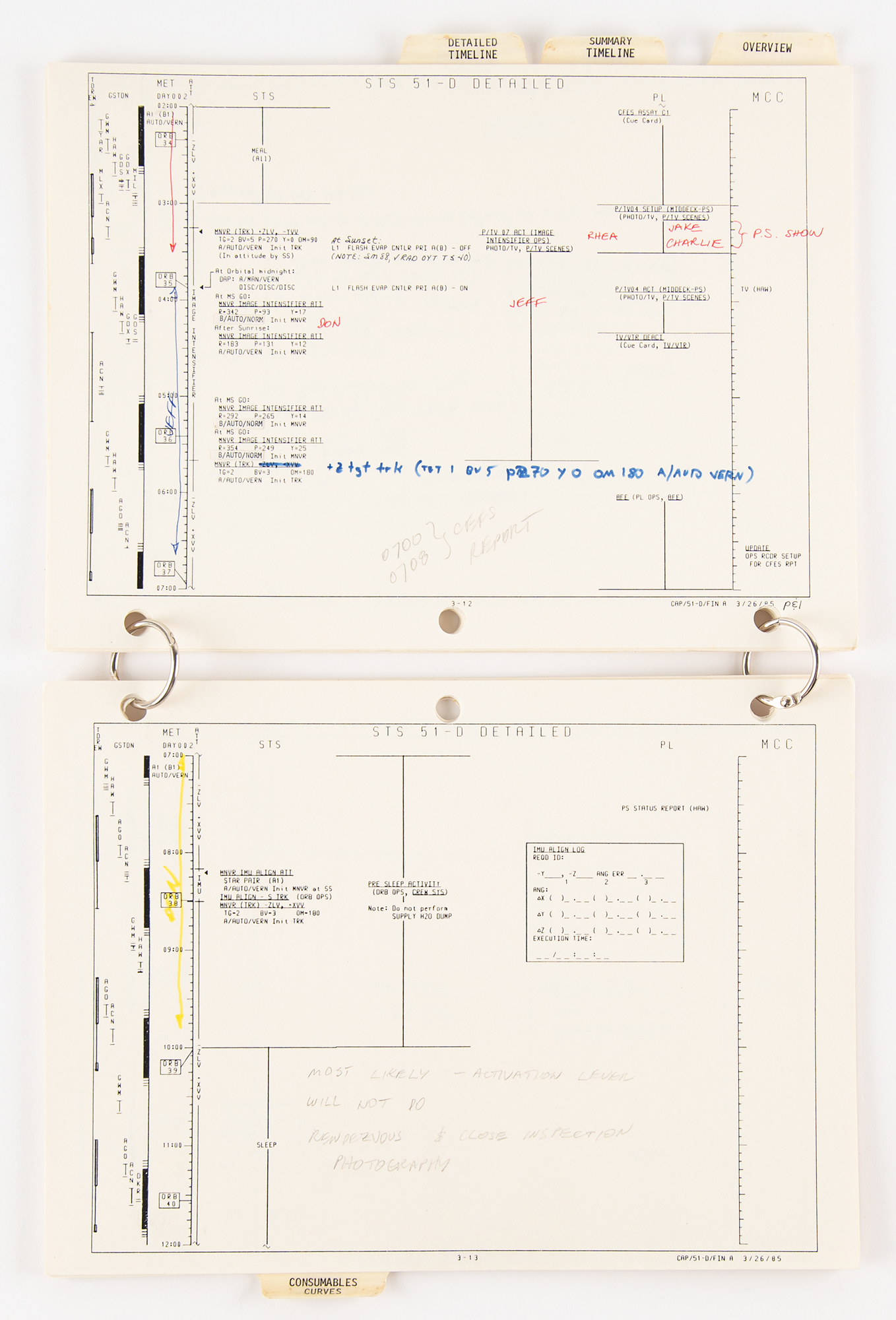
Flown ring-bound “Crew Activity Plan” that was carried into low Earth orbit during the STS-51-D mission, the fourth flight of the Space Shuttle Discovery, which launched from the Kennedy Space Center on April 12, 1985. The manual, 46 pages, 8 x 11, bears red labels affixed to the top of the front and back covers identifying the owner as Commander Karol J. Bobko, who has signed and flight-certified the front cover in black ballpoint, “This book was flown and used by me on STS-51D, Karol ‘Bo’ Bobko.” Of the manual’s four main sections—Overview, Summary Timeline, Detailed Timeline, and Consumable Curves—Bobko has added extensive handwritten notation to the ‘Detail Timeline’ section, with pages 3-2 through 3-23 featuring notes in variations of ink, pencil, and felt tip. Additionally, the back cover bears a pencil sketch and notations: “MOD #3, Rectangular Aluminum frame, contingency H2) supply kit, Cut notches in top – smaller and one each side, Use blue blue, 2 pieces 2 inches, 20 gage wire inside hose, loop 20 gage wire inside.” The front cover bears an affixed insignia sticker. In fine condition, with expected signs of use.
The primary objective of the STS-51-D mission was to deploy two communications satellites—Telesat-I (Anik C-1) for Canada and Syncom IV-3 (Leasat-3) for the U.S. Navy. While Telesat deployed successfully, Syncom IV-3 failed to activate after release, prompting an unscheduled spacewalk by astronauts Jeffrey Hoffman and David Griggs, who attempted to trigger the satellite using improvised tools attached to the shuttle’s robotic arm, though the satellite was ultimately recovered and fixed on a later mission. The flight also carried numerous scientific experiments, including biomedical and materials-processing studies, and featured U.S. Senator Jake Garn as a payload specialist, making him the first sitting member of Congress to fly in space. Discovery landed at Kennedy Space Center on April 19, 1985, but suffered brake damage and a blown tire during rollout, leading NASA to temporarily move subsequent shuttle landings to Edwards Air Force Base until improvements were made.