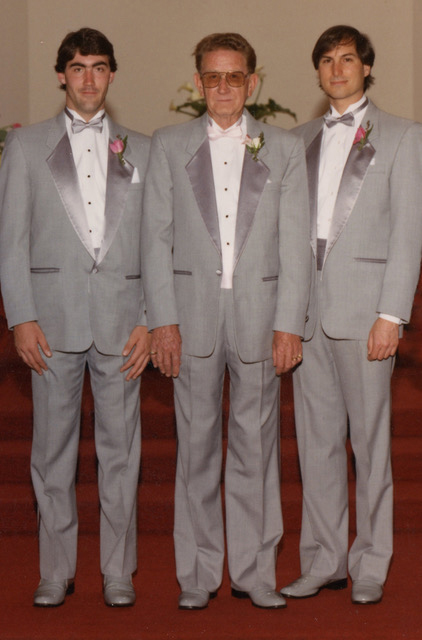
John Chovanec grew up in Palo Alto, California, where his childhood was surrounded by the early hum of Silicon Valley. A lifelong collector, he gravitated from coins to comic books, then to vintage sports cards—objects that connected him to stories, eras, and remarkable individuals. By the early 1980s, Apple Computer was becoming one of those stories. Little did John know that by the end of the 1980s he would have a personal link to Apple and become Steve Jobs’s stepbrother.
John recalls his father coming home in 1980 and announcing he had purchased stock in Apple Computer, Inc., explaining it had been founded by “these young local kids.” As John advanced through Santa Clara University, Apple computers lined the library: first Apple IIs and then Macintoshes. Steve Jobs’s reputation permeated throughout his business classes. His senior capstone focused on the case study of Apple, including its decision to oust Jobs from the very company he had founded. Today, John remembers it as “the most interesting assignment in my four years at Santa Clara University.”
In 1986, Steve Jobs lost his mother. In the same year, John lost his father to cancer. In 1989, John’s mother, Marilyn, met Paul Jobs in Los Altos, and the two married the following year with Steve Jobs as the best man. John remembers Steve’s lighthearted toast about how the couple were “acting like 17-year-old kids,” reflecting the joy they had found together. Paul embraced John as his own son, and through Paul and Marilyn, John witnessed a private side of Steve Jobs. He was warm, attentive, and deeply connected to his family. “I think Steve had a special spot in his heart for my mom as he could see how happy she made his dad.”
One afternoon at the Jobs family’s Los Altos home, famed as the site of the ‘Apple Garage,’ Steve led John into his childhood bedroom and powered up the Macintosh he had gifted to his father. For 45 minutes, Steve walked through the computer’s capabilities and explained challenges they faced during development. John recalls thinking, “How am I privately sitting with Steve Jobs in his childhood bedroom, demonstrating the Mac on his childhood desk… To me this was like sitting down with Willie Mays or Joe Montana in the house they grew up in.” This was one of their many candid conversations about life, work, and early Apple adventures.
When Paul Jobs passed away in 1993, Steve served as executor of the estate. John remembers: “Paul had given my mom a life estate to live at the Apple house... After Paul’s funeral we were in the dining room when my mom told Steve she felt funny living there... Steve took charge and explained that his dad wanted this for her and I quote: ‘You need to live here until you drop.’”
In the aftermath, Steve Jobs visited the Apple house several times to help organize and dispose of his father’s belongings. Steve’s childhood bedroom still contained the desk on which he had studied and dreamed throughout his youth. Inside it remained traces of his early path—Atari papers, Reed College notepads, HP manuals, and other relics of a life before Apple. Though John and his mother encouraged Steve to keep the desk and its contents, Steve declined, explaining that although the desk held “a lot of memories,” he had no use for it. When John asked if he could have it, Steve told his stepbrother, “Take it.”
Similar moments unfolded throughout the house and its two garages, where Steve left behind posters, manuals, tapes, business cards, and other personal mementos Paul Jobs had preserved with immense pride. John recalls being surprised that Steve did not reclaim even an early Apple poster: “The family room had an early 1977 Apple Computer poster on the wall that Steve had gifted to Paul. I remember Paul telling me how proud Steve was of this poster at the time, as it was made soon after Mike Markkula had funded Apple.” The only items he chose to keep were his childhood photographs stored in the attic.
John joined Apple in 2005 and quietly informed Steve Jobs by email during his first week. He received a reply within minutes welcoming him to the company. Over the years, they shared brief, low-key encounters on campus, often when John brought his mother, Marilyn for lunch. In these moments, Steve showed warmth and concern for her well-being. Even then, Steve consistently declined to reclaim personal artifacts from his youth, including a high-school project stored at the family home: "I told him several times about the school project display and that my mom really wanted him to have it...Steve would tell me to leave it where it was. I finally told him my mom was adamant as it was stressing her out so if he wasn’t going to take it, I was going to take it to my house. This was the first time I had debated with Steve and received an intense look from him. He responded, ‘Fine, but I don’t want to be bothered about it again.’”
For more than three decades, John has quietly safeguarded these pieces of history, cherishing them for their cultural significance and family value: “Steve was always so kind to my mother. She stayed and lived in the Apple house until she passed away in 2019.” After retiring and passing on his sports, comic, and coin collections, he now believes these extraordinary artifacts should move into the public sphere, where they can be appreciated by historians, collectors, and admirers of Steve's legacy.
This exceptional collection represents an intimate link to Steve Jobs’s early life—rooted not in Apple’s corporate rise, but in the family home where his ideas first took shape. Through John Chovanec’s stewardship, the personal history of one of the world’s most influential innovators has remained intact, waiting for its next chapter.